The Derby Scheme, initiated by Herbert Kitchener’s new Director General of Recruiting, Edward Stanley, 17th Earl of Derby, aimed to use strong-arm tactics to try to pressure men regarded as eligible to serve in the military to voluntarily enlist.
Every eligible man, aged 18 to 41, who was not in an essential occupation was required to make a public declaration of whether he would enlist immediately or defer his service to a later date, to appear when called. Men were sent to canvass all those eligible at their home address, and every man had to say whether or not he would attest to join the forces. Tactics varied from making the target guilty and embarrassed, to just outright threats.
Ultimately, the Derby Scheme would succeed in recruiting around two-thirds of single men, and half of those who were married to “join up.” In November and December alone, 318,553 medically fit men joined the colours.

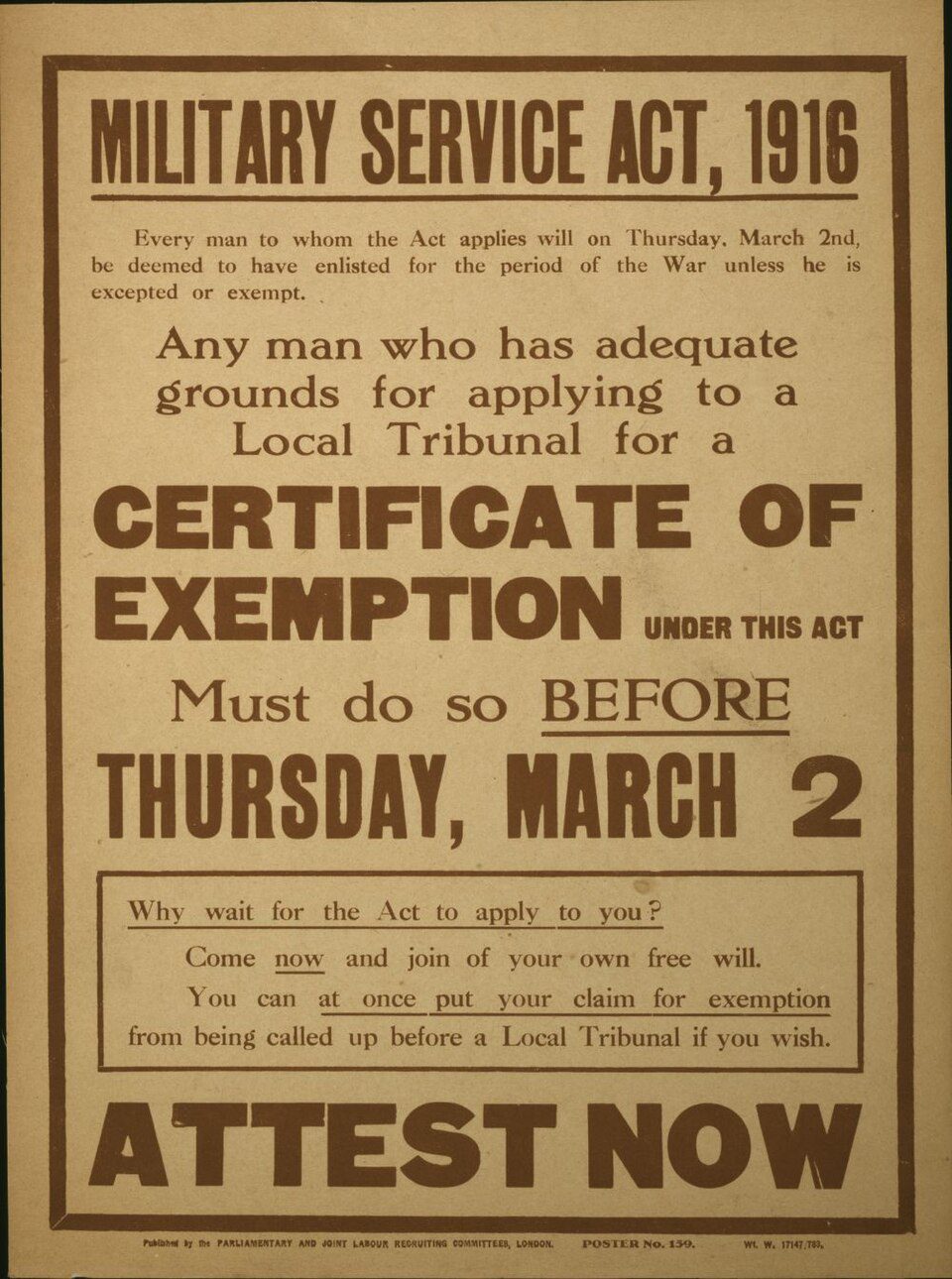
Not satisfied with the result of the Derby Scheme, the British government would go on to pass the Military Service Act 1916, which authorized conscription, on 27th January 1916, to secure the remaining eligible men for war service. It came into force on 2 March 1916.
The act specified that men from 18 to 41 years old were liable to be called up for service in the army unless they were eligible for exemptions listed under this act. Exemptions included men who were married, widowed with children, serving in the Royal Navy, a minister of religion, or working in one of a number of reserved occupations, or for conscientious objection.
A second act in May 1916, the Military Service Act 1916 (Session 2) extended liability for military service to married men, and a third act, the Military Service Act 1918, extended the upper age limit to 51.
Men or employers who objected to an individual’s call-up could apply to a local military service tribunal. These tribunals were often chaired at the local Parish Council, and had powers to grant exemption from service, usually conditional or temporary, under the eligibility criteria which for the first time in history included conscientious objection. There was right of appeal to a county appeal tribunal, and finally to a Central Tribunal in Westminster, London.