
Captain Geoffrey Brownfield Phillips
1/5th (Cinque Ports) Battalion Royal Sussex Regiment
26th (Bankers') Battalion, Royal Fusiliers
Junior Section, Officer Training Corps
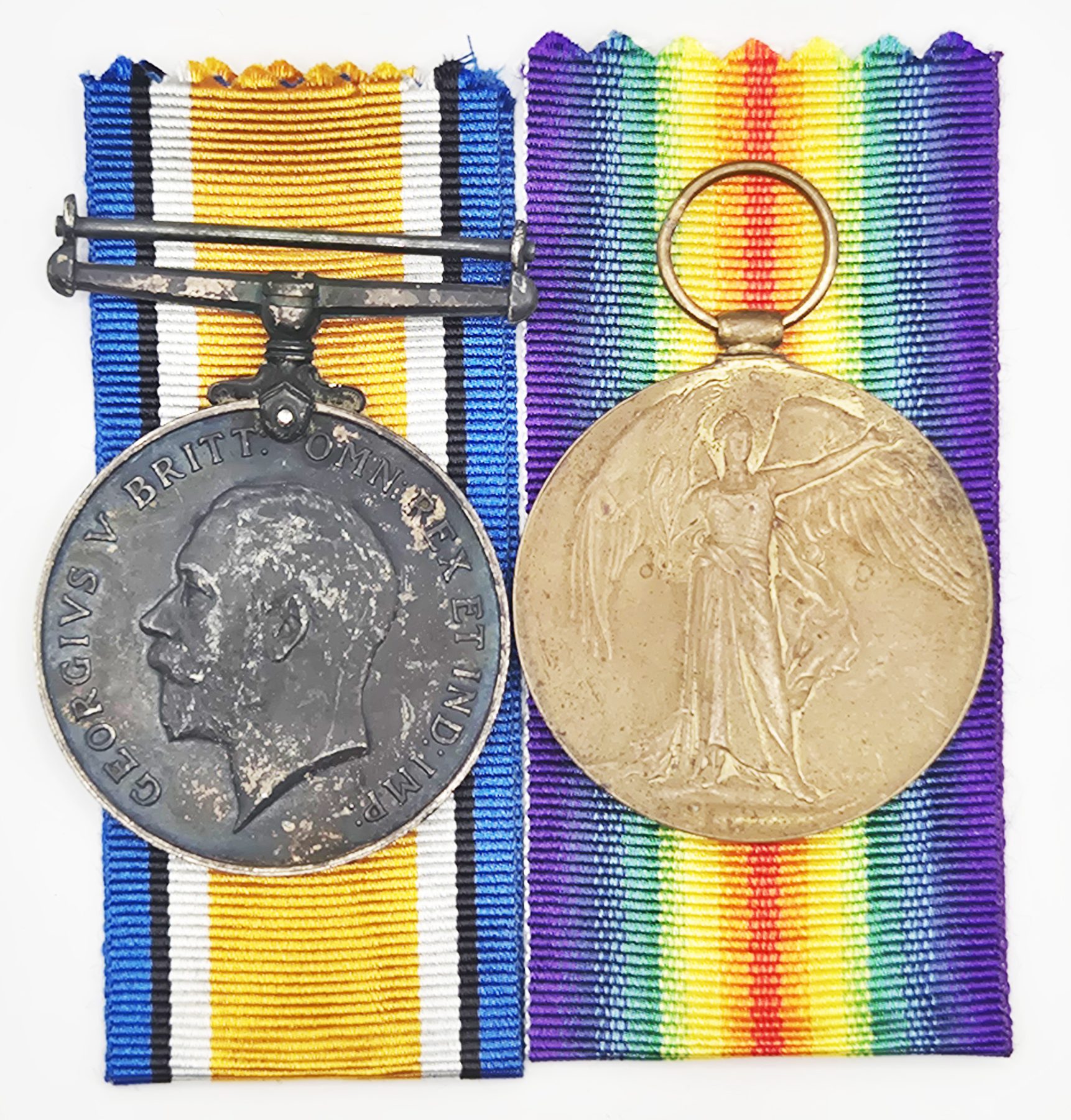
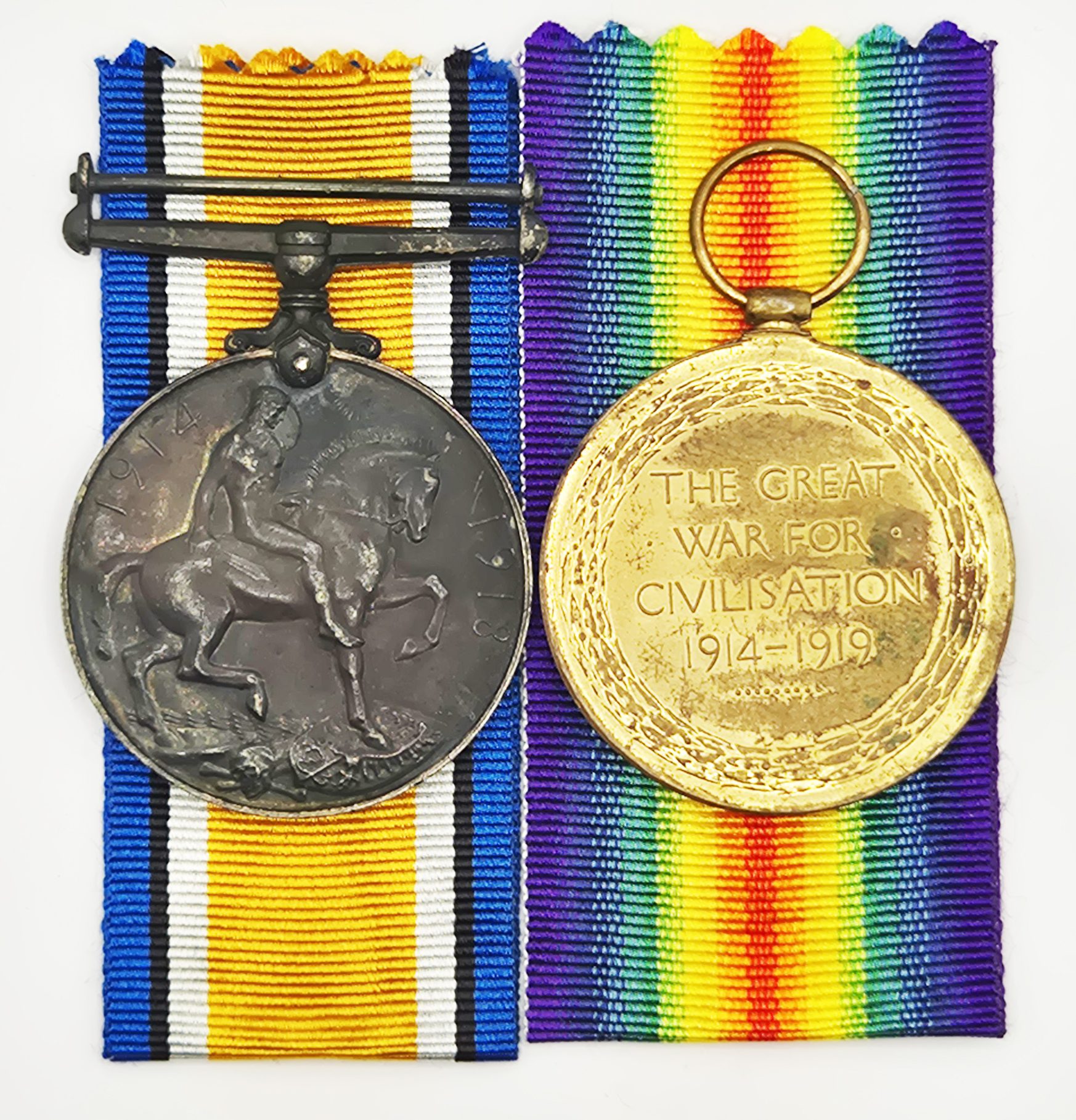
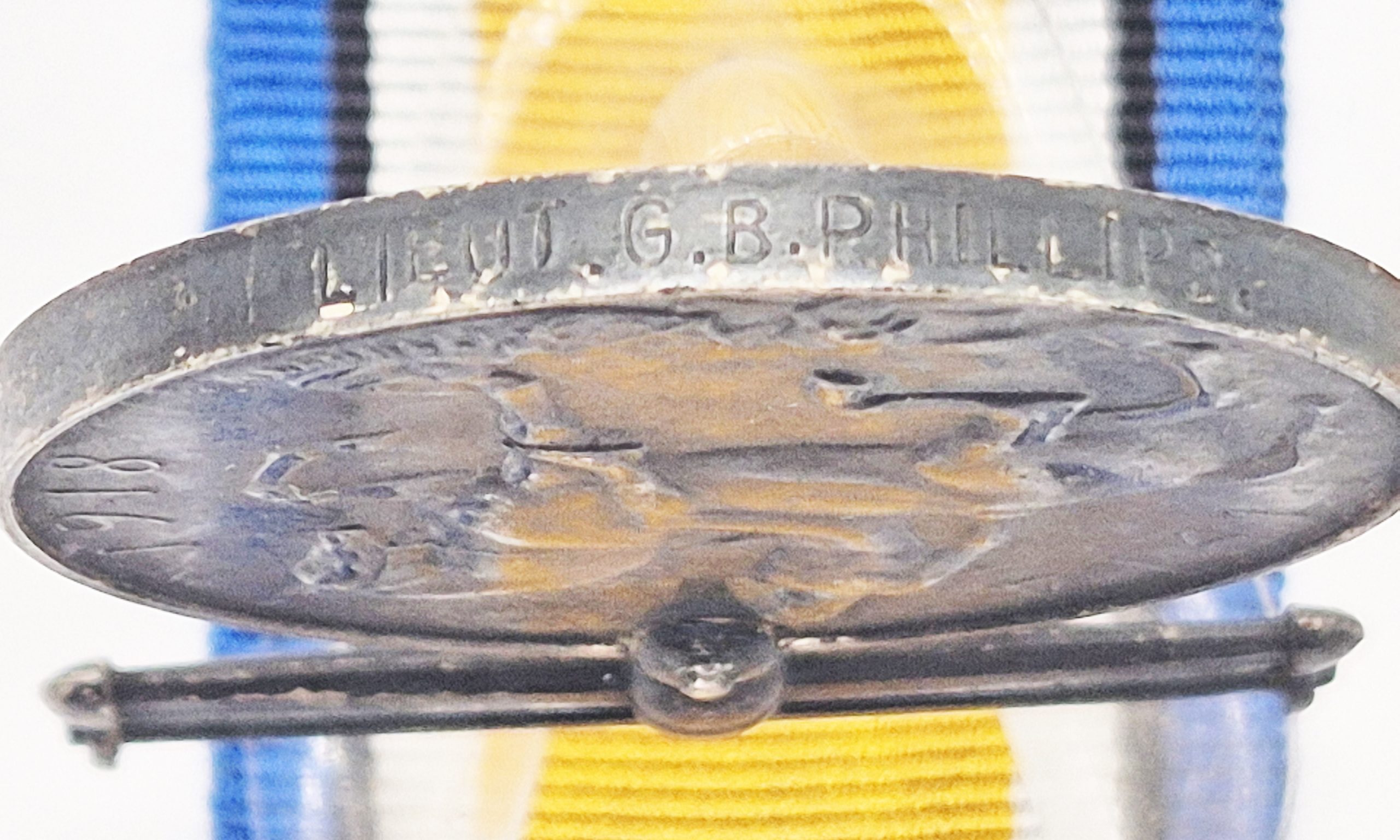
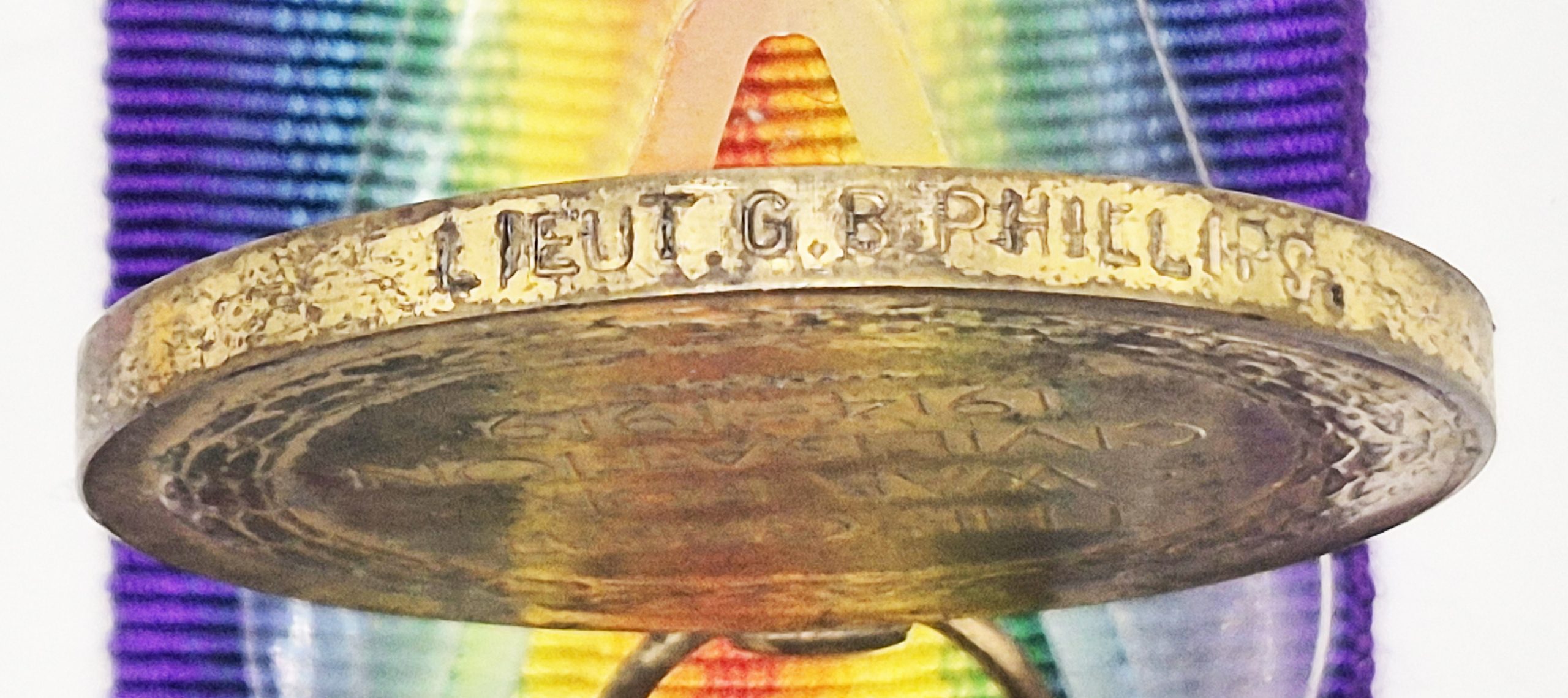
British War Medal and Victory Medal

Geoffrey Brownfield Phillips was born in Hereford in 1887. On the 1891 Census he is shown (aged 3), living with his older brothers, William (11), Arthur (8), and sisters Nora (13), and Gwendoline (1). His parents were Ellen (40) and William (37).
He later attended Lincoln University, and by 1911 twenty-three year-old Geoffrey was living in Market Bosworth in Leicestershire as a boarder in the large home of a widow by the name of Edith Alice Hewer who lived with her three sons (12, 14 & 15) . The young sixteen year-old servant completed the household. He was at this time employed as an assistant schoolmaster.
In September 1914 he would move to Kent and take a job as a schoolmaster at Maidstone Grammar School. He is commissioned as a Second Lieutenant in the school’s Officer Training Corps on 14th October 1914.
After the Derby Scheme of 1915 (whereby men were pressured into volunteering for the colours) failed to secure enough recruits, full conscription was activated under the Military Service Act 1916. Whilst schoolmaster was not a reserved occupation as such, most cases were dealt with on an individual basis. Local education boards were often given the authority to determine whether an individual, who may otherwise be conscripted, would be allowed to stay in their post. Sometimes cases would be sent for review to the Central Recruitng Commitee for a final judgement.
It is unclear when, or indeed under what circumstances, Geoffrey transferred for war service, but he was promoted to Lieutenant in the Royal Sussex Regiment on 1st July 1917.
He landed in France on 18th April 1918 and after passing very briefly through the 26th (Bankers’) Battalion, Royal Fusiliers, he served with the 1/5th (Cinque Ports) Battalion (Territorial Force) of the Royal Sussex Regiment. At this time the unit was part of the 48th Division command as the Pioneer Battalion.
Most units in France and Flanders had a need for officers to replace those lost to enemy action. He arrived at a time when the British Army was preparing for what become the Third Battle of Ypres, otherwise known as the Battle of Passchendaele.
The division was heavily involved in fighting through the latter half of 1917, including at the following battles: Langemarck, Polygon Wood, Broodseinde, and Poelcapelle.
The 1/5th Sussex left with the rest of the 48th Division on trains for the Italian front on 21st November 1917, to hold the front line at Montello between 1st-16th March 1918, before moving West to the Asiago sector.
Later that year they would see action at The fighting on the Asiago Plateau (15th-16th June) and The Battle of the Vittoria Veneto (1st-4th November) (but in the Val d’Assa rather than the Vittoria Veneto itself).

On 28th November 1918, Geoffrey was promoted to temporary Captain. The London Gazette states it was whilst in the role of Eucation Officer. He later reverted back to the rank of Lieutenant in April, having ceased to be an education officer.
Geoffrey would return to his post at the Grammar School, and serve as head of the history department, and later second master (deputy head). He also resumed his role as an officer in the Officer Training Corps, The London Gazette entries show him transferring from the 5th Sussex back to the OTC in September 1919, which included promotion to Captain and Officer Commanding of the unit.

The OTC at the school had both an Army and Royal Air Force section, and he wore both uniforms over the years, one photograph shows hi wearing the equivalent rank of Flight Lieutenant.

The 1921 Census shows him (now 34 years old) living wife his wife, Alice, and her mother at 16 Lancet lane, Loose, Maidstone, Kent.
In 1928 he leaves the role of Officer Commanding of the OTC at the school, but continues to serve as a Captain. Many years later, on 25th June 1937, he retires a serving officer, retaining his rank and the right to wear uniform.

Retiring in 1958, he served the school in numerous ways for 45 years. He taught English, History, and Divinity, and he was reportedly dearly loved by all his pupils, who enjoyed his special form of humorous wit. I include an article below, written after his retirement in full, taken from the school magazine “The Maidstonian,” 1961 (Volume 72).
MR. G. B. PHILLIPS : M.G.S. 1914 – 1960
“So each of us comes, stays his appointed time, and goes, leaving his small place, slight in achievement though not void perchance of some accomplishment, generation upon generation, life upon life, till Time grows old in looking back and the Present cancels with its petty urgencies the confused Past, only a little kept in recollection, the rest forgot.”
Thus Mr. Phillips wrote in the beautiful prologue to his Chronicle Play One Day We Shall Remember. And truly. Yet, in the long succession of professional lives that make the four hundred-odd years of the School’s annals, the mastership of G. B. Phillips is, and is likely to remain, unique.
For endurance, first. He came to Maidstone in September, 1914, and gave his last lesson there on Thursday, 14th July, 1960. You’d say such as sleep o’ nights and live dawdled days might do it, given an idle chance. But this spare, wiry, restless man? It seems he had no time to note time’s passing, no attention ever to attend to fatigue, absorbed as he was in his subject, in his teaching, in the School whose life was his.
And that is the second reason for his uniqueness. Quite surely no man has ever so completely embodied in his own person and biography the personality and history of a school in the period of its richest development. Not a pie he hadn’t a finger in. He commanded the O.T.C., produced for the Dramatic Society, took up the double bass when the orchestra was formed and played it consistently until 1954; he sang in the Choir from its inception, was a founder member of the Choral Society; he was Senior House Master of School House from 1937 to 1957; for twelve years he was secretary of the Parents’ Association; his election, two years ago, and his re-election in 1959, to the Presidency of the Old Maidstonians’ Society is an unprecedented testimony not only to the respect and affection in which the men he taught as boys hold him, but also of his unfailing interest in them.
Meanwhile his contribution to the School’s academic life was not less remarkable. He made his mark at all levels, from Beta to Omega, from the Junior School, of which he was appointed Head in 1919, on his release from War Service (he had joined up in 1915 and become Civil Staff Captain 124 Brigade, Education Officer), to the Sixth of which he became form master in 1922. He was the first to see and seize the opportunities of the thirties, enhanced here by the stimulus of new, spacious and worthy buildings. Now Second Master and Senior History Master, he took over and developed the Library, started the stream of Scholars (27 Open and 7 Gunsley awards in History) and Commoners (Heaven knows how many) that has flowed ever since between the School and Oxford and Cambridge and the other Universities, and set for colleagues and boys alike a standard of efficiency and effectiveness, as well as of loyalty and courtesy, which influences us to this day. He was an exceptional teacher, brilliant with the Sixth but no less successful and concerned with the humblest class of plodders. He dotted the i’s and crossed the t‘s of all he organized; you’d be cute to catch him out over any one of the n thousand text-books he took charge of for twenty years or so, with his blue and yellow cards.
1949, the School’s quatercentenary, was Annus Philippianus. For it, he wrote the Chronicle Play, which the Dramatic Society performed, published his short history of the School, which could well be reprinted for general issue, and he brought the year to an end with the finest act, as it turned out, the last of his own Christmas Concerts of his which have become legendary.
That would have been about enough for a normal man. But Mr. Phillips believed – and rightly, though, in today’s conditions, futilely so – that a schoolmaster should be active in the community outside the school, to the advantage of all three. He was; and in every sphere with distinction. He took a special interest in prison work, and was for long Chairman of the Home Office Committee for Discharged Prisoners; it was always a source of special satisfaction to him that his service and his ability in this field were recognized at the national level by his election to the Vice-Chairmanship of the National Association of Prison Visitors. He was district representative of and lecturer for the Society for the Preservation of Rural Kent. He was Vice-President of the Town Community Club. In the Second War he was head warden. In his own professional organisation, the I.A.A.M., he played a prominent part, and was for some time Chairman of the West Kent Branch.
A significant destiny, such as his, needs for its making the almost miraculous happy matching of person and circumstance, man and moment. One can no more see G.B.P. in the isolation of a cell or a crowd than Doctor Johnson in a Trappist monastery. That eighteenth century urbanity, that Volitarian wit, that unpretantious but quite unmistakable elegance of speech, style and bearing, that delight in immaculate organisation, not of but in concert with others, these are qualities which need the community for their display. Community, mark you, not a mere concourse.
Mr. Phillips was lucky in his moment. It has been said, notably by our own Headmaster in his lecture at the University of Leeds, that the distinctive contribution of this country to education is the conception of the school as a community. Was, Sir, already – so far as the greater day schools are concerned – was. For the past half century has seen the unstayable evolution of the major Grammar Schools of the country from families of a hundred or so, having at most an embryonic sixth form and little social life outside games, simple scouting perhaps, and a Cadet Corps, but living very intimately, each knowing all, into the large instructional institutions of the nineteen sixties. For about twenty-five years in between, the most fully evolved of these Grammar Schools, such as Maidstone, were communities in the fullest sense, combining all the cultural and social advantages of size with all the warmth and reality of the “family.” They were astonishingly vigorous organisms, with definite personalities and personal ways of life. They were a joy to work in because a joy to live in. You struck roots in them. They should have been a source of national pride.
That was the moment and the milieu in which Mr. Phillips flourished. At every supper (and every body of any size, house, society, troop or corps, threw a supper at least once a season, and invited all the masters and delegates from every other body) the piece de resistance was one of those exquisitely witty speeches of G.B.P.’s, delivered with a shyness of manner that turned genuine nervousness most cleverly to histrionic advantage. And you’d brave a blizzard if you knew (and you got to know) that G.B.P. was also to render The Bailiff’s Daughter (who lived in Is-ling-ton) or maybe I’ll go no more a-Roving (with you – fair – maid) but, mark you, beautifully, in a pleasing light, “lyrical” tenor, legacy of Hereford Cathedral (vowels and all).
At every form party (and every form you could call a form threw a party once a year) some pretext was found for including G.B.P. among those who “took” them, if only for detantion. Such bodies as the Orchestra prefaced the weekly meeting with a tea which G.B.P. would convert into a charming social occasion.
His Christmas Concerts were – and there’s no other word for them – unique, but literally unique. For their range, for one thing; with his compèring he could square red-nose with high brow, Janeck with jazz, shockingly, and most enjoyably; For their taste and their spirit, for another. For example, those famous “Staff Items” of his invention, which year after year brought the curtain at the house down, and in which he would get the masters, all the masters, cutting the most academic capers as Pirates of Penzance or Policeman, or, o tempora, o mores, Lovelies of Arabia “softly sighing” – they were not only uproariously funny, they were impeccable in taste, beautifully finished and, believe it or not, positively beautiful in themselves. No wonder those shows so far from weakening actually deepened the mutal respect and affection that bound our community together.
It was one and the same man, in one and the same manner, got us speculating in chorus on what – spirit of inquiry? pusuit of beauty? – kept a Tinker, a Tailor, a Soldier and a Sailor all waiting at the Old Barn Door, and conducted, behind the closed doors of the Book Room, what must have been some of the most tantalizingly witty and brilliant conversations of our times, in the form of Scholarship History Periods. He could infuriate fresh young colleagues with his theories and compel their wonder at his practice; for a boy before him was not a specimen, nor a case, nor even a receptacle, but a fellow human being implicated in the same slightly absurd world as himself. For the courtesies, however, he was a stickler; he thought civilisation a delicate and precarious artefact that would not survive the uncivil or the impersonal.
But deep down, at the ‘Still Point’, what was the man? Perhaps no-one knows, for the peculiarly civilised and, therefore, stylised relationships he cultivated with the world about him precluded intimacy. Only …. occasionally he would let fall a remark that would set the attentive wondering; were the sparkling persiflage and the ceaseless activity an escape from his awareness there are tears at the heart of things? And was this, perhaps, the secret of his uniqueness?
Kings and public houses serve to mark the distances in time and space; and rare is the man or the monument can usurp their function. It is so, too, with Headmasters and ordinary ones. But though two at least of the four Heads G.B.P. served under were themselves exceptional men and eminent, yet “Phillipsian” is and will remain the mot juste for the forty-six years that ended last July. And in the gratitude that term will connote till we are dead who knew them we include the lady who made the best of him – Mrs. Phillips. May they live many happy years to enjoy their past achievement and our present affection and pride.
E.C.J.

After a very full life of dedication to service and education, Geoffrey “Beta” Brownfield Phillips died on 21st May 1973 in Shropshire. The probate records show he left an estate of £33,081.
Special thanks to the Old Maidstonian Society for helping with information and the numerous photos.


