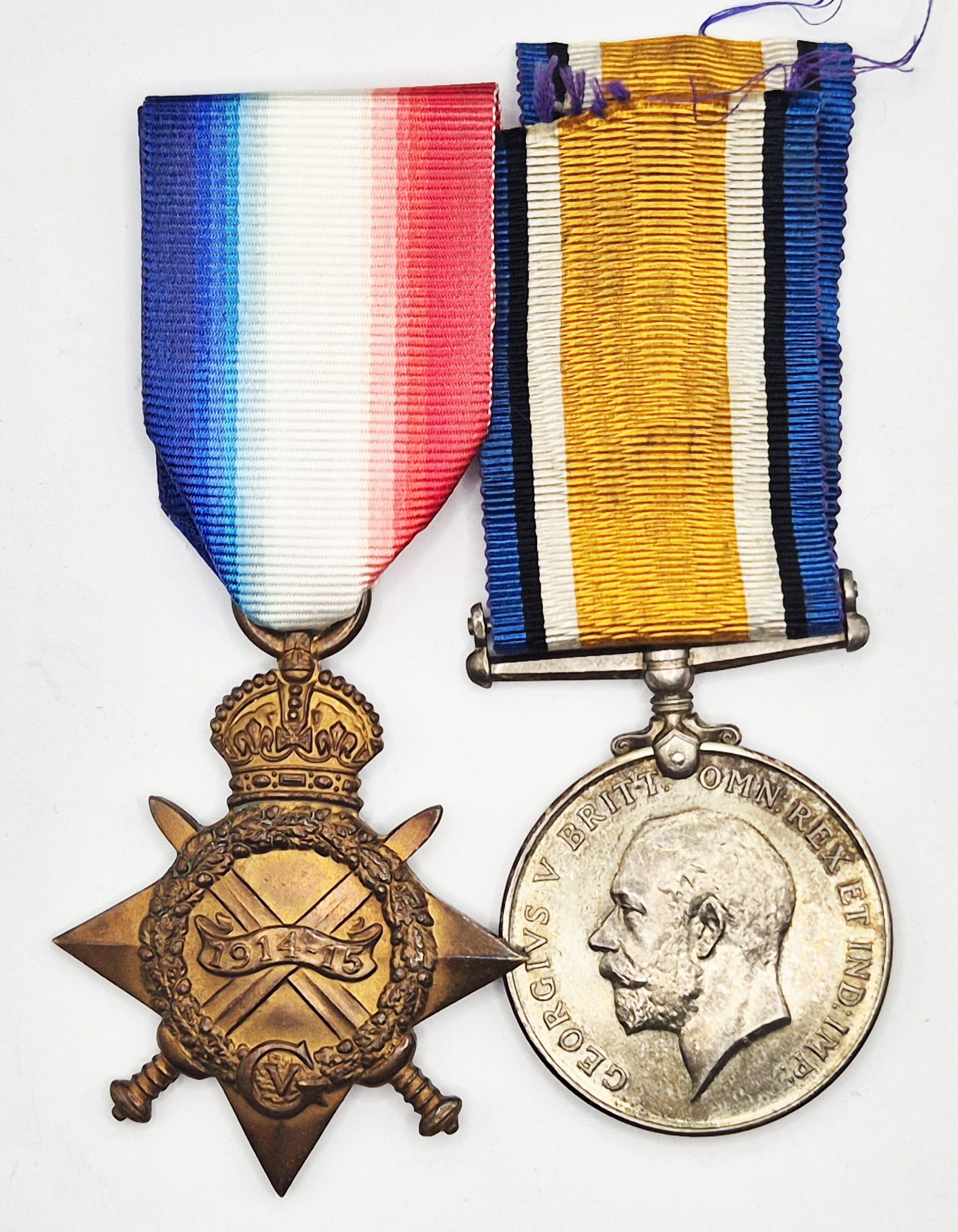
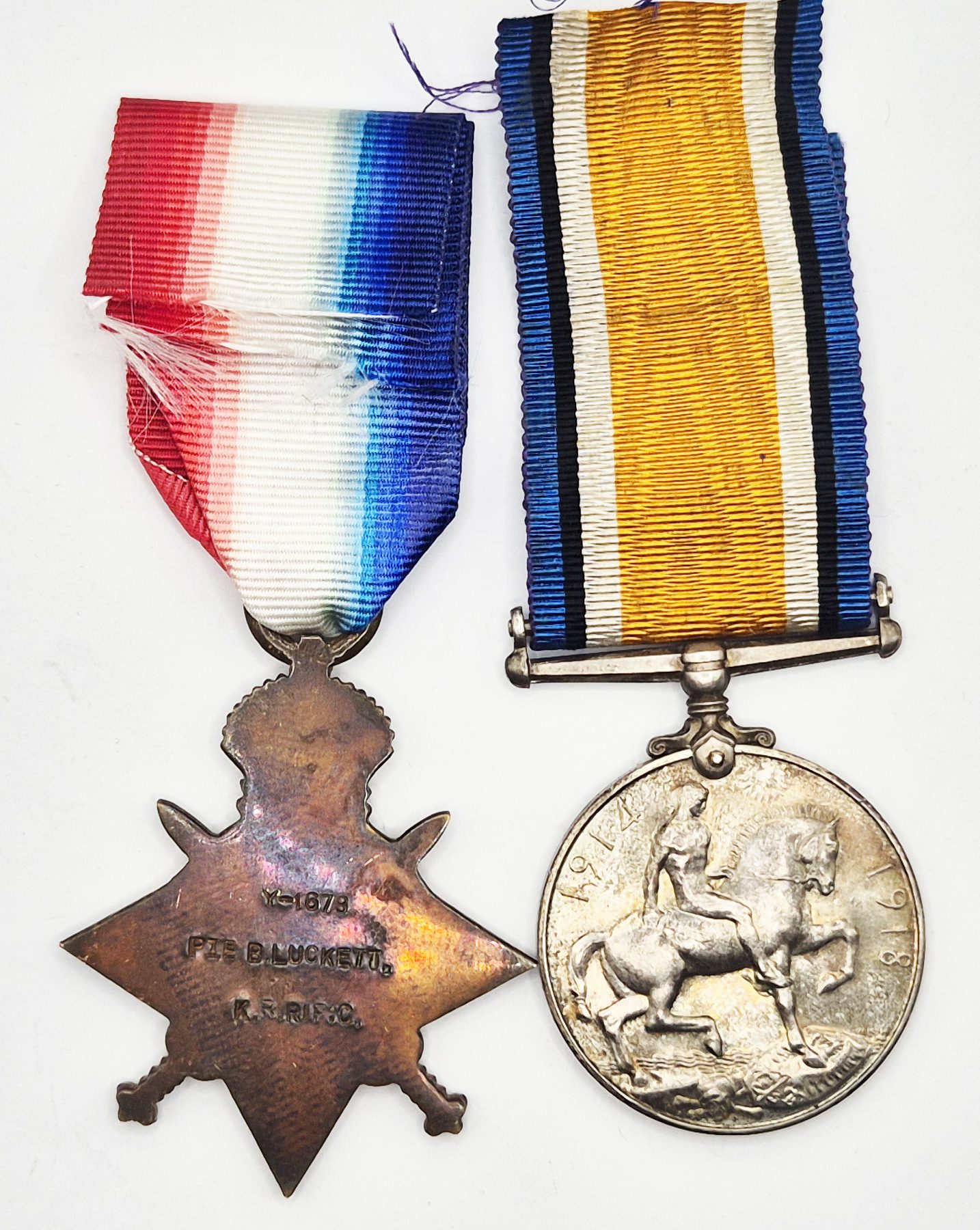
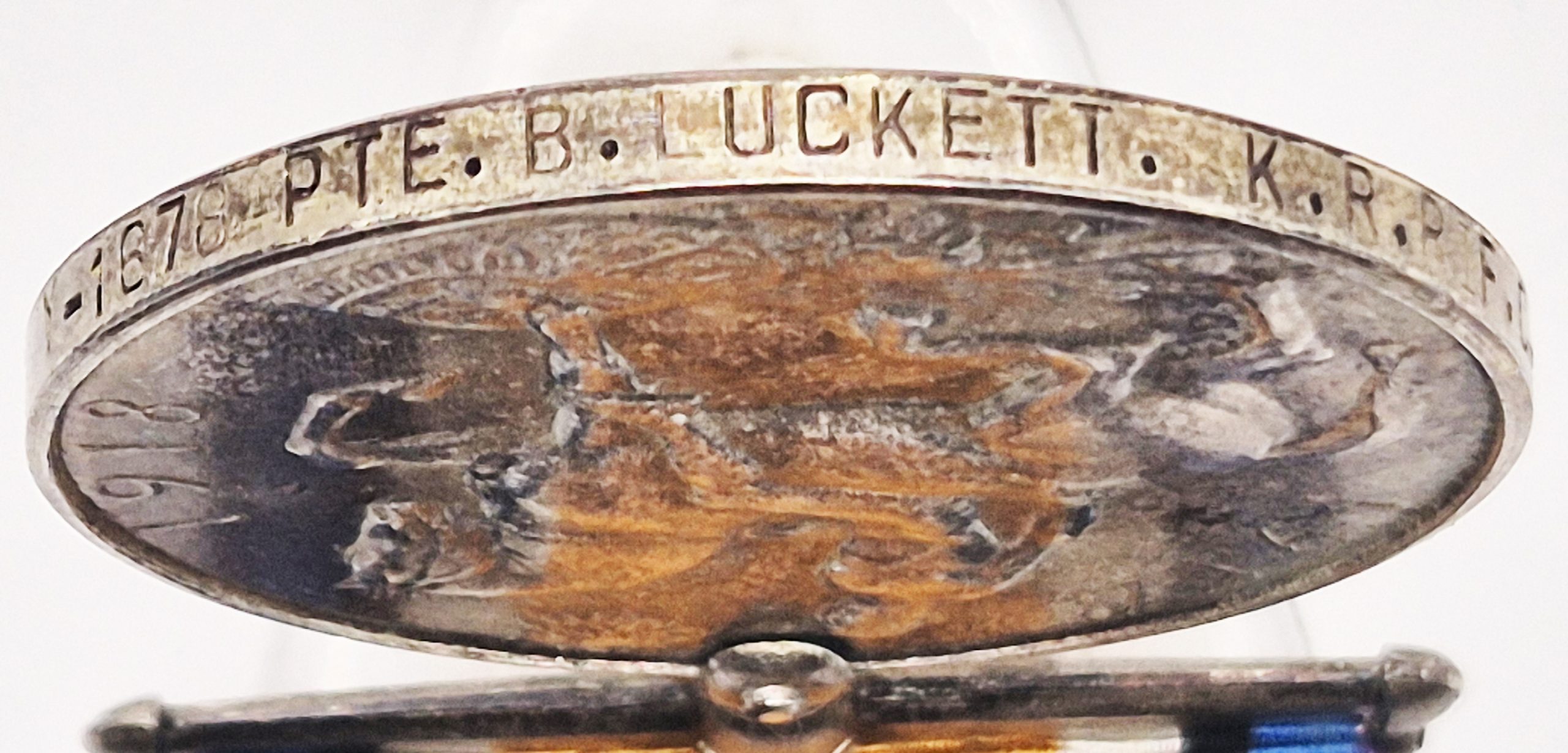
Y/1678 Private / Rifleman Benjamin Luckett
4th Battalion, Kings Royal Rifle Corps
1915-15 Star and British War Medal
(also entitled to Victory Medal)
FAMILY
Benjamin Luckett was born in 1897, the only son of Benjamin and Harriet Luckett. They also had two daughters, Harriet and Edith, and another, Nellie, who had died aged only 6 months.
Harriet (mother) died aged 43 in 1909. Benjamin (father) remarried in 1911 to Maud Allchin. Benjamin (father) was the landlord of the Rose and Crown Pub, Wouldham, Kent, from 1901, until his death there in 1929. The pub building no longer exists, but it is shown here prior to demolition.
After working as a cooper for a few years, our Benjamin was an early volunteer, and attested to join the colours, probably sometime around the outbreak of war.
To War
On 19th January 1915, Benjamin landed in France and was posted as a replacement to the 4th battalion, King’s Royal Rifle Corps. The battalion were assigned to the Ypres Salient, near what was once the village of St. Eloi, immediately to the South of Ypres. The area was dominated by a feature known as “The Mound,” an old man-made spoil heap from the neighbouring brickworks.
The end of January saw the battalion moved a few times, being mostly held in reserve until it took over the frontline from a battalion of the Royal Irish Regiment. A patrol from A company, lit by a bright moon took heavy fire and suffered 12 casualties, and the French trenches to their left took a heavy artillery bombardment. They withdrew and returned to billets at Dickebusch on the 31st.
The battalion’s war diary gives a very detailed analysis of the state of the trench system at St. Eloi. The following information is summarised from the full report. The front in this area was not continuous, and instead relied on multiple short sections of trench to create a front line (click image to enlarge).
The trenches were mostly waist deep in mud and water, unfit for occupation. Movement along the trenches was almost impossible, with men frequently having to be pulled out to avoid drowning. The communication trenches were unusable, and a considerable quantity of ammunition and supplies were lost in shell holes on the way up to the front line. Rations are brought in during the nights through the badly pitted and shelled ground to the rear. So arduous was this task, it could only be completed once, with the slow movement taking almost all night.
The dugouts, though, were mostly dry and usable, and the trench provided adequate cover from enemy fire. Communication was an issue, with constant artillery interruption, and the telephone line’s insulation becoming waterlogged so quickly, they had to be replaced every night. Finally, the battalion headquarters were located in a very unsanitary basement, owing to an old cesspool.
Most of February was spent alternating between the trenches and in billets to the rear, with work repairing and reinforcing the support and communications trenches at various parts of the nearby front. The battalion took some casualties due to shelling at this time. A long line of “breastwork” was fortified. Where in some places the ground was so waterlogged that it was impossible to dig trenches, breastworks were constructed instead which were comprised of sandbags stacked up and sometimes piled behind with mud and dirt to provide rudimentary shelter for the troops.
On the 14th, the Germans attacked on the left flank of St. Eloi, capturing some of the waterlogged front line trenches numbered 19, 19a, 20, 21 and 22. The rest of the month was fairly uneventful, apart from some shelling, with most days taken up with digging and improving fortifications and creating new breastworks where digging was not possible.
Counter Attack
On the night of the 1st-2nd March The 4th KRRC formed up behind the new breastworks to counter attack the Germans who had previously captured their front line trenches. The plan was to rush trench 21, clear it, then advance along to clear the new German line that ran behind 20-19, which they also occupied. The attacked was actioned at midnight, and the first wave managed to enter the trench as planned, causing the Germans to immediately flee. With many being shot and killed in the open as the lead company opened up with their machine guns from the cover of the trench.
A small number, including bombers advanced (via Z on map) towards point X (on map), throwing bombs (grenades) in an effort to clear the way through. At the same time, the main lead attack of D company headed forwards out of trench 21 into the new German trench (marked Q), and headed along it, reaching a heavily defended barricade, in an effort to flank around it, they left the cover of the trench into the open, but were swept with gunfire and many were immediately killed. The futility of this effort was realised, and the men were instead ordered to stay and attack from the trench itself, come face-to-face with the barricade.
By the time the next wave (B and C company) arrived there were only a handful of men for D company remaining, unable to press forward due to the trench now being blocked with dead and wounded men, killed by gunfire from the barricade, which was reported to be “a kind of miniature fort, (barbed) wired all round and loopholed.” The loopholes were usually small slits cut into bullet-proof steel plates, enabling the defender to fire out, with maximum protection from any returned fire.
Eventually, trench 21 was held and prepared for defence, but none of the other objectives were taken, mainly due to the enemy’s preparedness and the bright moonlight failing to provide much cover in the darkness. The casualty list for the battalion for the action on the night of 1st-2nd March alone was 33 missing (many feared dead), 16 killed, 61 wounded.
Action of St. Eloi
Heavy shelling continued all along the Ypres Salient on-and-off, culminating in what would be known as the “Action of St. Eloi,” on 14th-15th. At 5.30pm on the 14th, heavy artillery on both sides opened up from the direction of Dickebusch, with the battalion being stood ready at 6.15pm. They were marched through Dickebusch to drop off their packs, then on to trenches halfway between there and Vourmezeele.
By midnight they were ordered to march to the sunken road between Shelley Farm and St Eloi, all the while hearing the artillery and gun fire from the ensuing battle, they received word that the Germans had captured a number of trenches across the sector and their column became disorganised and strung out during their march with the confusion of other troops of the 82nd Brigade falling back from these captured trenches.
Eventually, the battalion took position in trenches 9, 10 and 11, to the West of Picadilly Farm, with A company being sent to relieve the Royal Irish Rifles at the breastworks. British casualties for the action of 14-15th at St. Eloi totalled around 500.
The rest of the month was spent in and out of the breastworks and trenches at various points around St. Eloi.

Holding the Line
April was similar, with Benjamin’s battalion taking over front line trenches and the breastworks for short tours. On the 18th April, the battalion moved into dugouts at Bellewaarde near Hooge. Their first two days were relatively “quiet,” with the artillery that did occur not dropping on their area directly. At 5.45pm on the 20th, this would change, with a German bombardment with heavy howizers focusing their fire onto the guns to their north. Some shells fell short and dropped onto their position and killed four men.
On the 26th the battalion prepared for what they expected might be an attack from the enemy, as the night had gone by so peacefully, but all that came were some heavy bombardments at 4.10am, 11.15am and 4.10pm.
Death
21 year old Benjamin Luckett was killed by artillery in the front line near St. Eloi on 26th April 1915. His body was never recovered, and he is remembered with honour on the Ypres (Menin Gate) Memorial to the missing of the Ypres Salient, along with 54,588 other men of the British and Commonwealth forces with no known grave.
Benjamin is additionally remembered on the war memorial on the lych gate at All Saints Church in his home village of Wouldham, Kent.
He is also commemorated on the family tombstone, where his mother & father (along with their six month old infant daughter) and stepmother are buried together.