21/1189 Sergeant Joseph Owens Nurse
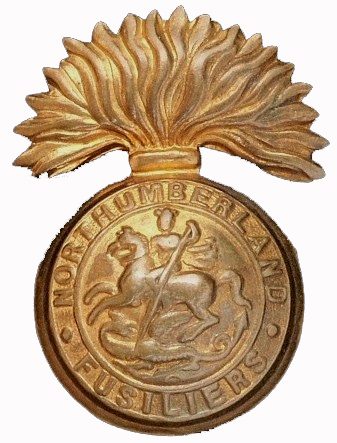
Northumberland Fusiliers
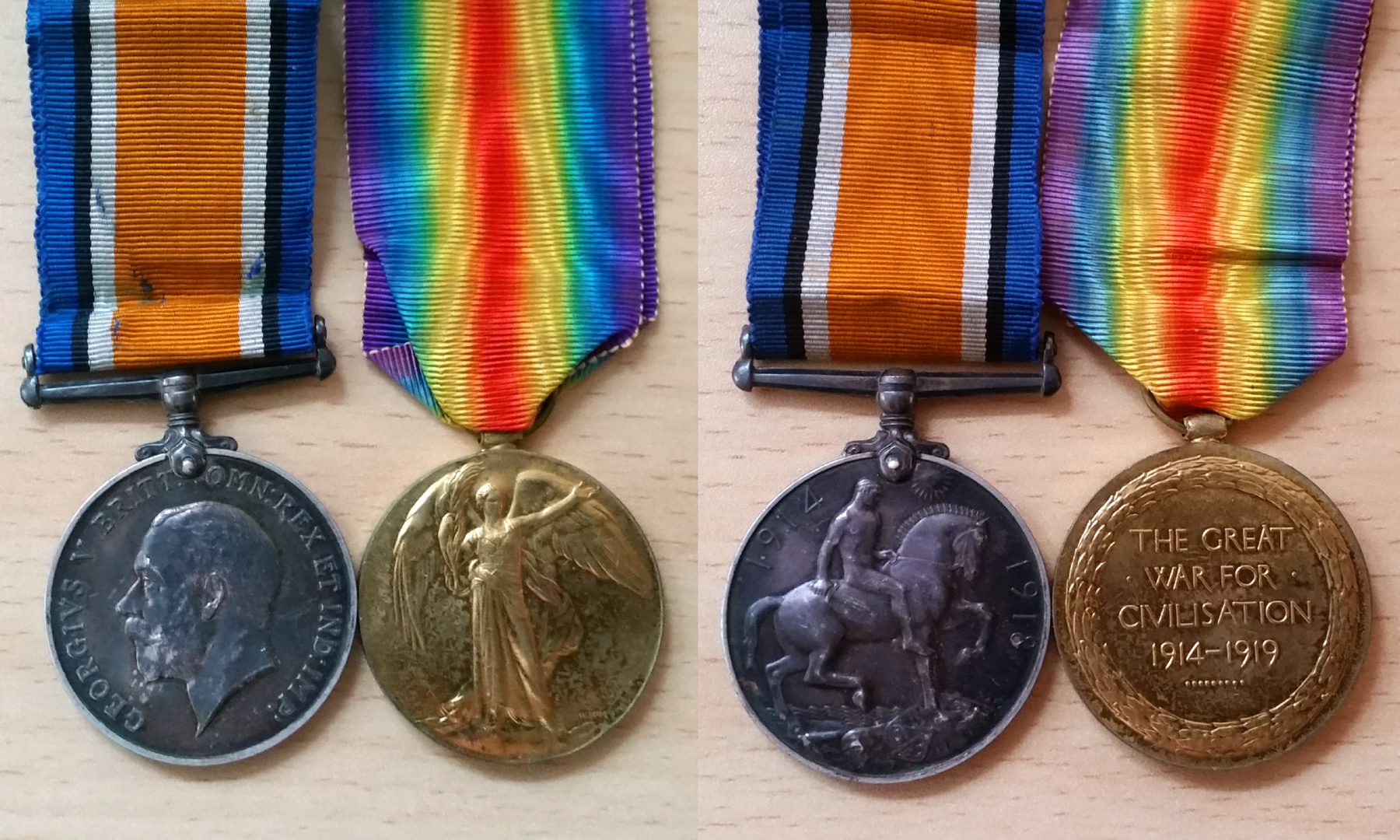
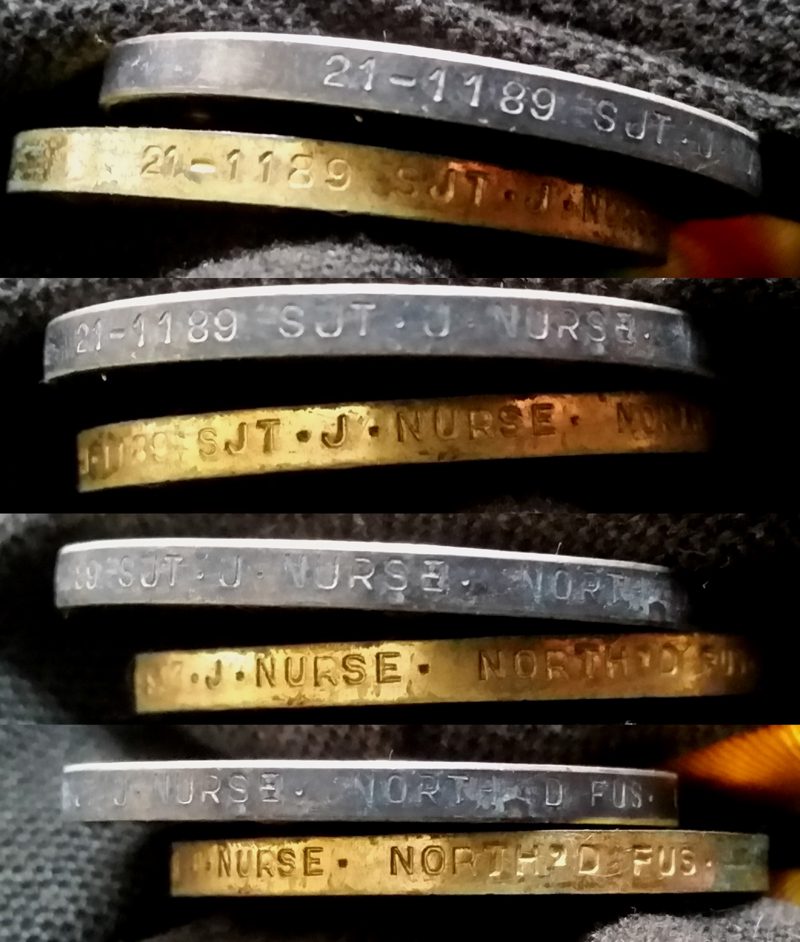
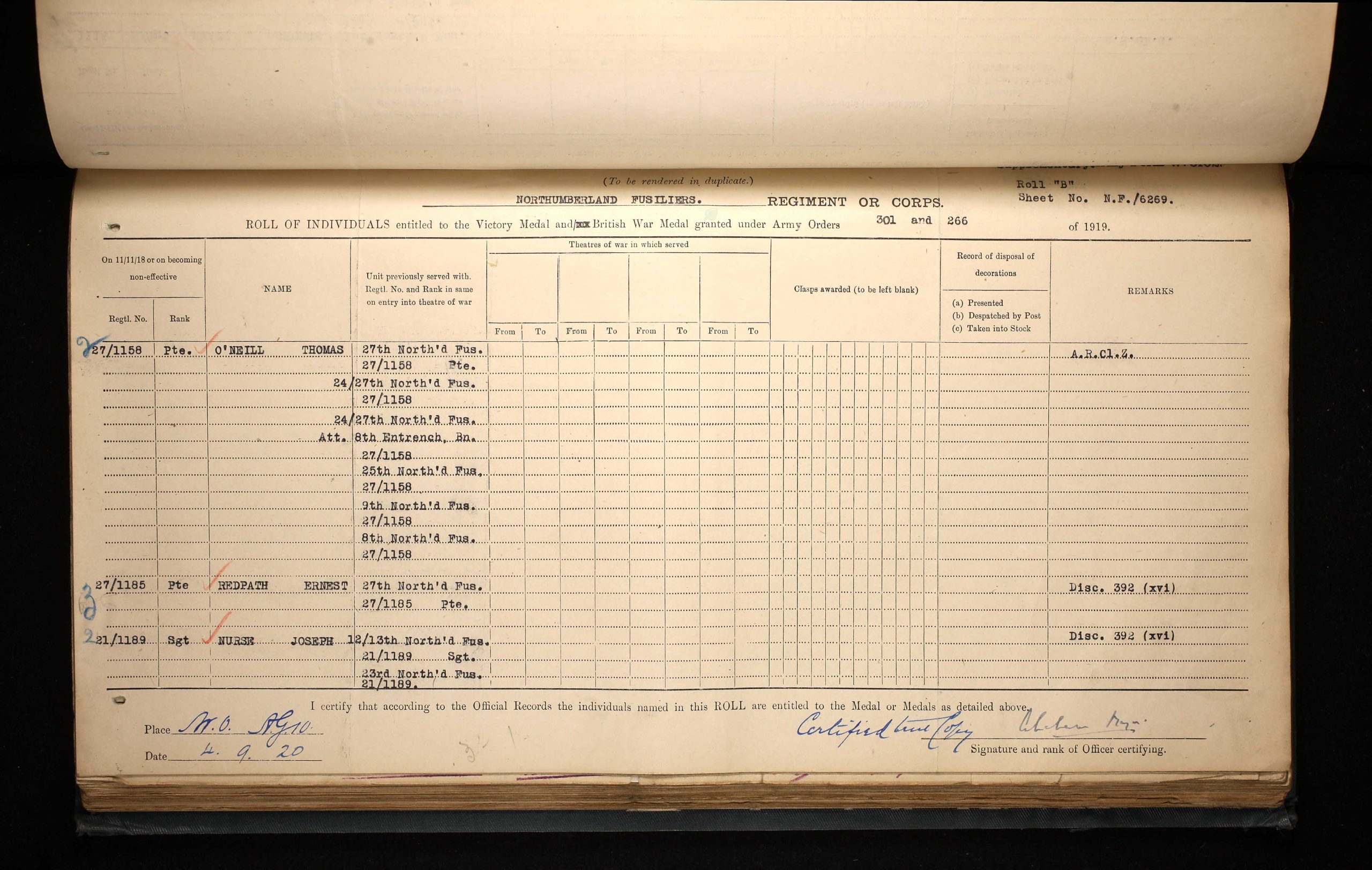
British War Medal and Victory Medal
(also entitled to Silver War Badge)
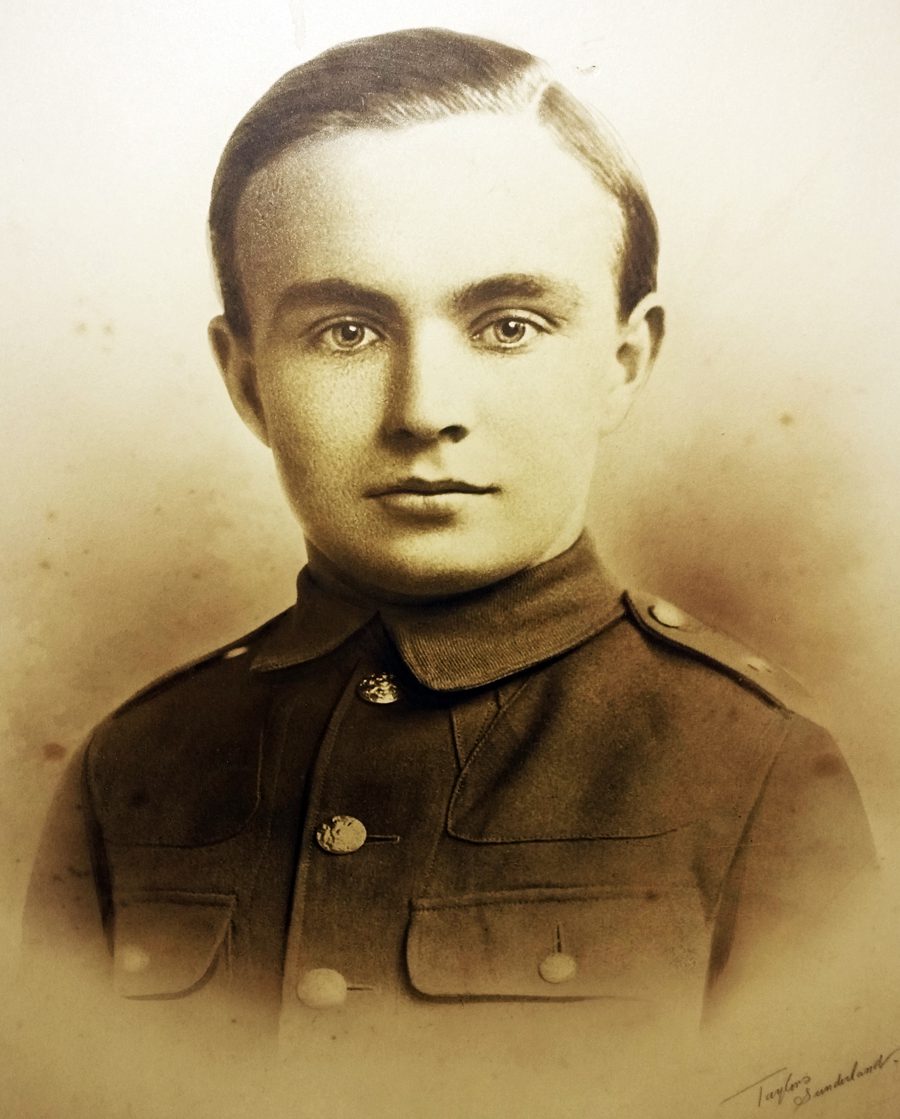
FAMILY
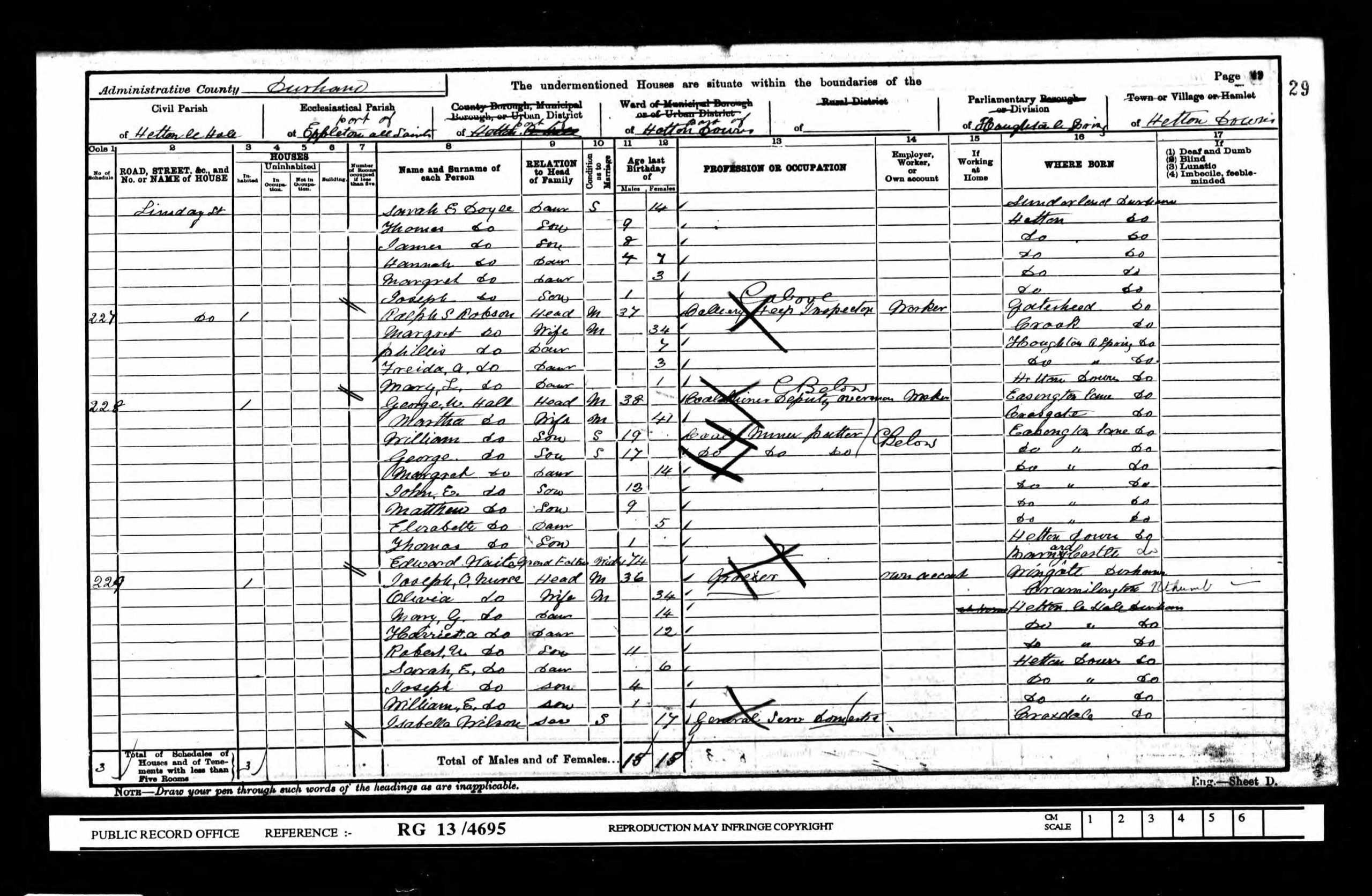
Joseph Owens Nurse was born in about 1897. The 1901 census shows him, aged 4, living in Hetton Le Hole, County Durham, England. The household consisted of his Father, also called Joseph Owens Nurse (36) – a grocer, his Mother, Olivia (34), and siblings – Mary (14), Harriet (12), Robert (11), Sarah (6), and William (1). The household also had a 17 year-old domestic servant, Isabella Wilson.
It would appear Joseph Owens Nurse (Snr) was determined to have a son with his name, as the couple had a infant son die in 1884, also called Joseph Owens Nurse.
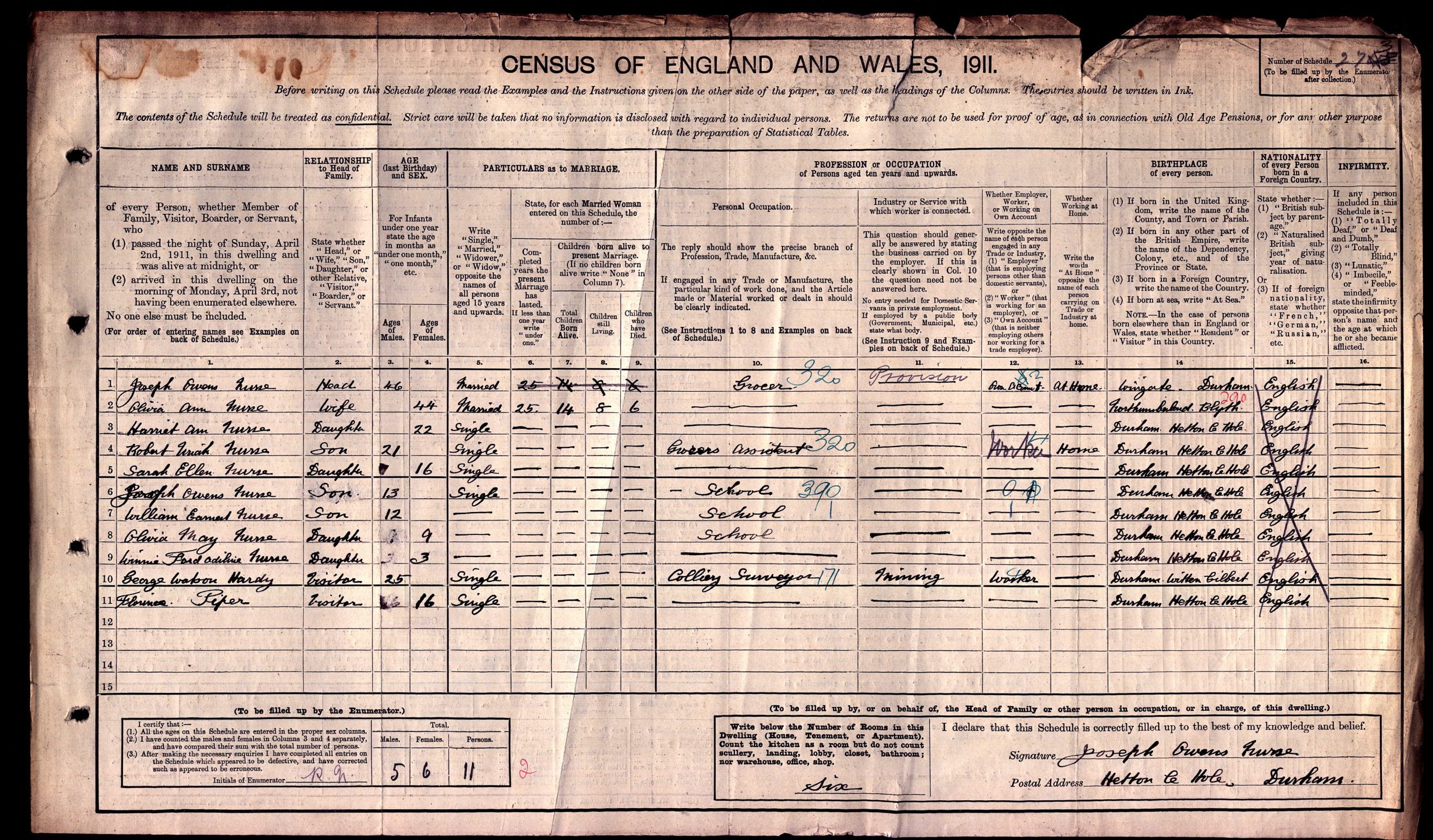
By 1911, the family had increased further – to add two more daughters – to bring the total to 8 children in total. 13 year old Joseph is still in schooling, and the eldest son, Robert (now 21) is now an assistant grocer, presumably working for their father.
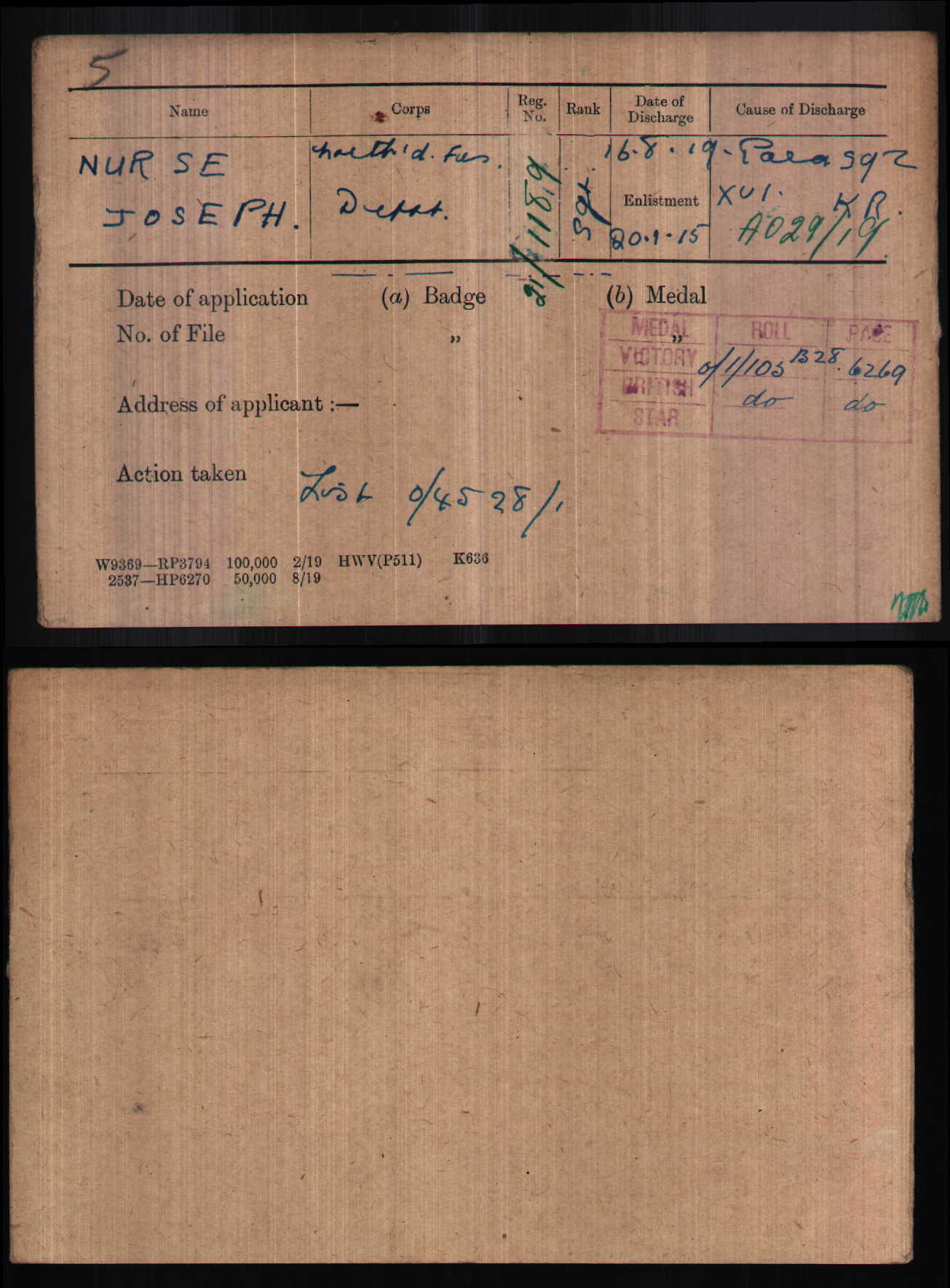
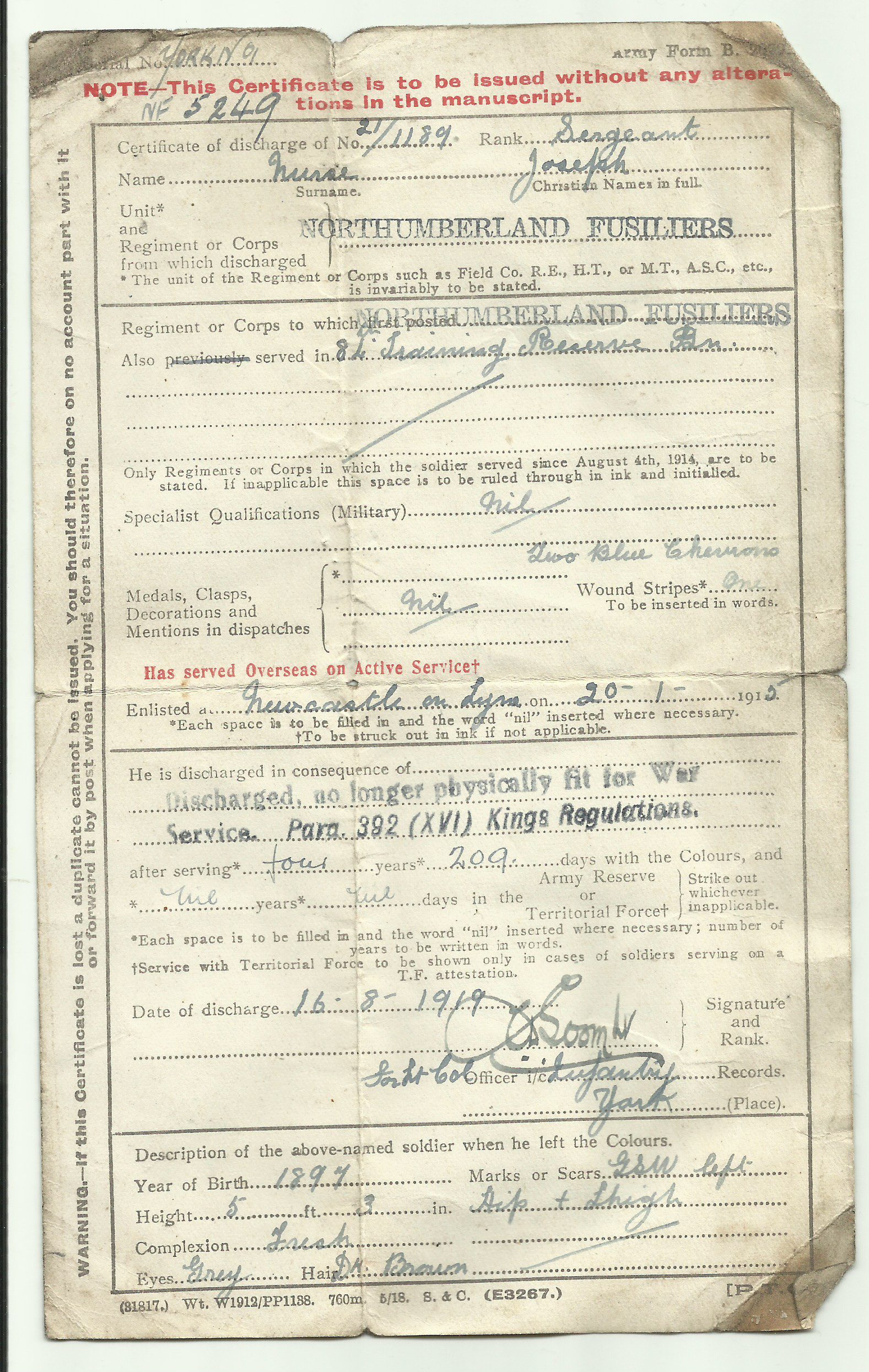
5ft 3in tall Joseph volunteered for service with the colours on 20th January 1915, probably on or around his 18th birthday. He enlisted in the Northumberland Fusiliers, serving in the 23rd Battalion, and later the 12/13th Battalion. His final posting was to the Depot Battalion.
Service Documents
As with a great many soldiers of the Great War, Joseph’s service records are missing. During the night of 7/8th September 1940, there was a heavy German air raid on London and the repository was hit by incendiary bombs, destroying the greater part of the 1,400 tons of War Office records which were held there in the subsequent fire. Approximately two thirds of service records were completely destroyed and those which survived were partly charred or water damaged when the fire was extinguished.
The remainder of his service is the best guess at the course of events, based on the documents that survive.
It is highly likely Joseph saw action at The Somme, and other areas of the front lines with the 23rd (Service) Battalion (4th Tyneside Scottish), who landed in France in January 1916.
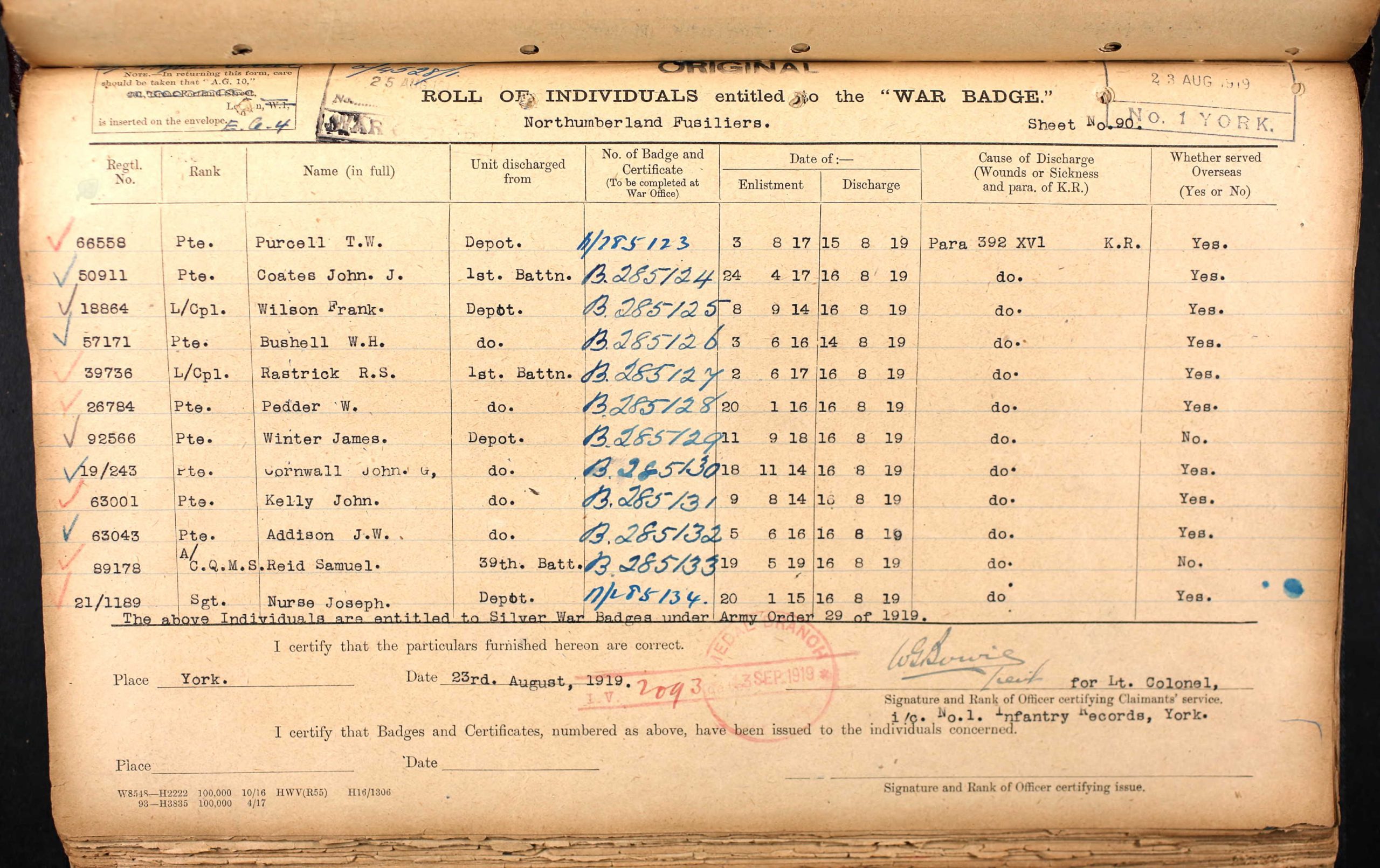
The 12/13th was formed on 10th August 1917, an amalgamation of the old 12th and 13th (Service) Battalions, and it is likely this is when Joseph transferred. The War Badge Roll notes it was in this battalion he achieved the rank of Sergeant, which, during the war, was usually a rank that was reserved for the pre-war soldiers who showed leadership abilities, and was not often bestowed upon “duration of war” recruits. He must have stood out as an excellent leader to achieve this rank in an infantry unit in the year or so of time he had spent in the army.
Joseph would be shot in the hip and thigh, most likely in March or April 1918. The action described below is mostly taken from the 2018 book “The Battle of the Lys: North: Objective Ypres.”
The Battle of Lys (German Spring Offensive)
The 12/13th Northumberland Fusiliers, as part of the 62nd Infantry Brigade, under the command of the 21st Division. On 21st March 1918, The Germans launched Operation “Michael” on a 70-mile front near Arras, on the Somme, with the 21st Division immediately engaged in brutal and desperate defensive fighting, sustaining a large number of casualties.
The total casualties on this day alone totalled around 38,500 British and 40,000 German men.
They were relieved a week or so later, and sent to French Flanders, to a sector which had been a relatively quiet sector of the front line since 1915, approximately halfway between Ypres to the North, and Armentieres to the South, in a village called Locre (today it is called Loker). They received a draft whilst there of mainly 18 year-old new recruits directly from England.
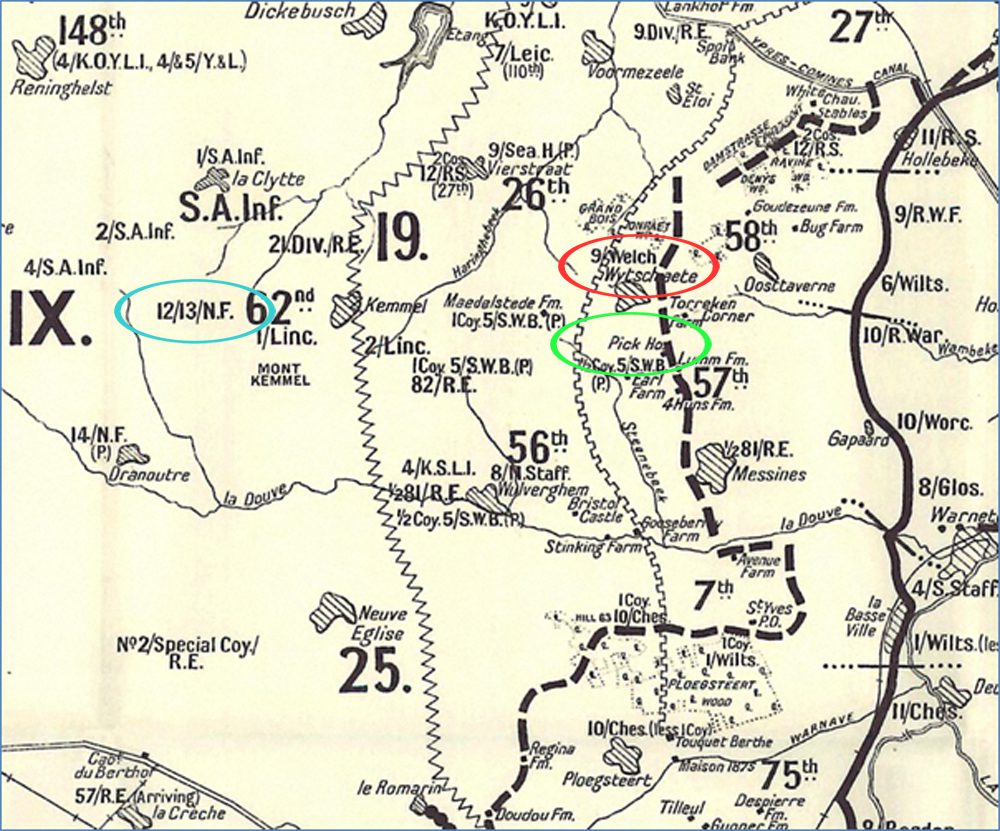
They moved East to hold reserve trenches at Wytschaete (now Wijtschate) (circled red on maps) for a few days before returning to the rear near the strategically important high ground of Mont Kemmel (now Kemmelberg). On 9th April The German Sixth Army began an attack a few miles South West of Armentieres, which continued into the following day, joined by a second attack by the German Fourth Army along the whole front as far North as Ypres.
The 12/13th Northumberland Fusiliers were ordered forward to join the defence of Wytschaete to support the 26th Brigade. The position was held all day on the 10th, but German Progress to the South threatened their right flank. The moved up to clear out any remaining enemy and take better defensive positions near Pick Farm (see map – circled green).
During the night they encountered German Patrols and encountered infantry and machine gun fire while advancing West of Wytschaete. There was also some brutal hand-to-hand fighting and some German artillery fire. By 5am the objectives were taken, and a second push West began half an hour later towards Torreken Farm. The rest of the day saw artillery bombardments and several German infantry attacks. The 26th Brigade held firm. A brigade report would later state that “under very heavy shelling the battalion moved forward splendidly and their steadiness undoubtedly saved the situation”.
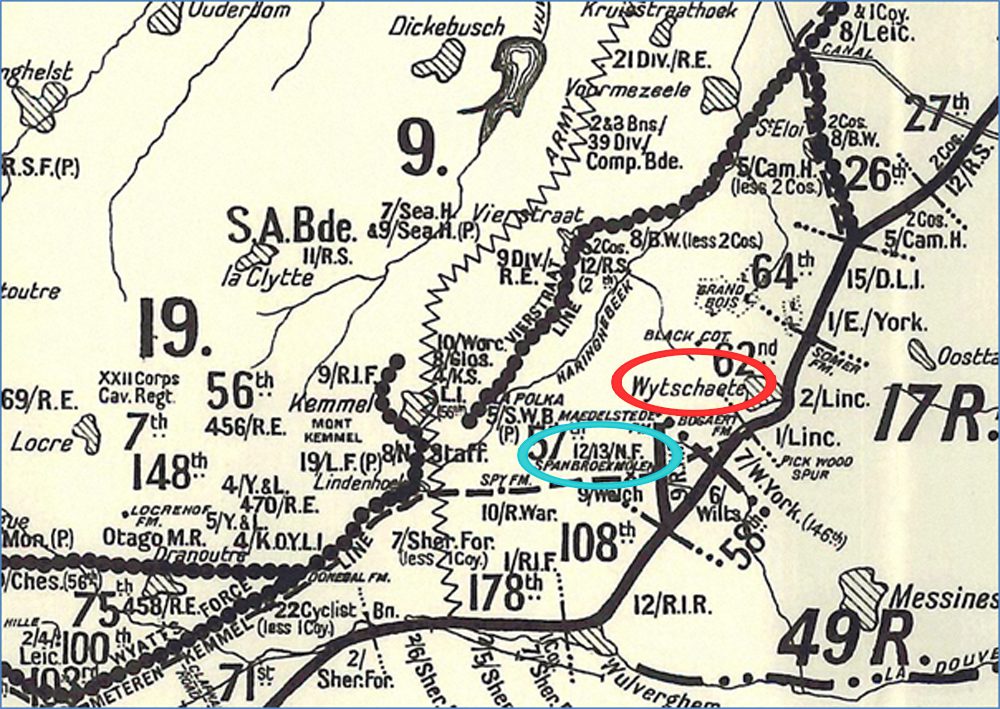
Wytschaete remained in British hands until the 16th April, when it was finally taken by the Germans. The 12/13th NF, who held the front south of here (circled blue on map above), was ordered during the day before, along with the entirety of the remaining British fighting force, back to the Vierstraat Line (the “black dotted line” on map).
At 5am, the British front here came under “a pulverising gas and High Explosive bombardment” and all telephone lines were cut. Messages were taken by runner under artillery barrage, while men tried to run new wires in open ground. There was very little shelter in what was now fast becoming the front line. With fog and smoke, visibility was so poor that men in separated posts would have only seconds to identify figures looming out of the fog and to even conclude they were under attack.
To the South of the 12/13th NF, Germans were now streaming through a gap in the front line left from breaking through the 7th West Yorkshire Regiment. They reacted by swinging and facing south in defence of its right flank, reinforced by a company from the 2nd Lincolnshire Regiment. One company became detached near Court Farm, and was completely engulfed by the enemy. The rest of the battalion held their ground despite intense artillery fire and constant gunfire from the Germans from their South.
The ground was held at a heavy cost. By the end of the day on 16th April, 300 officers and men (perhaps a third of their total number) of the 12/13th Northumberland Fusiliers were killed, wounded or captured, with the majority of these being taken prisoner. The action here would later be known as Battles of the Lys.
Germany was determined to make a huge push through to the Channel ports and drive the British Expeditionary Forces into the sea. The two major operations and subsequent attacks later became known as the Spring Offensives. From March until the end of July 1918, the number of casualties would total around 1.5 million men on both sides.
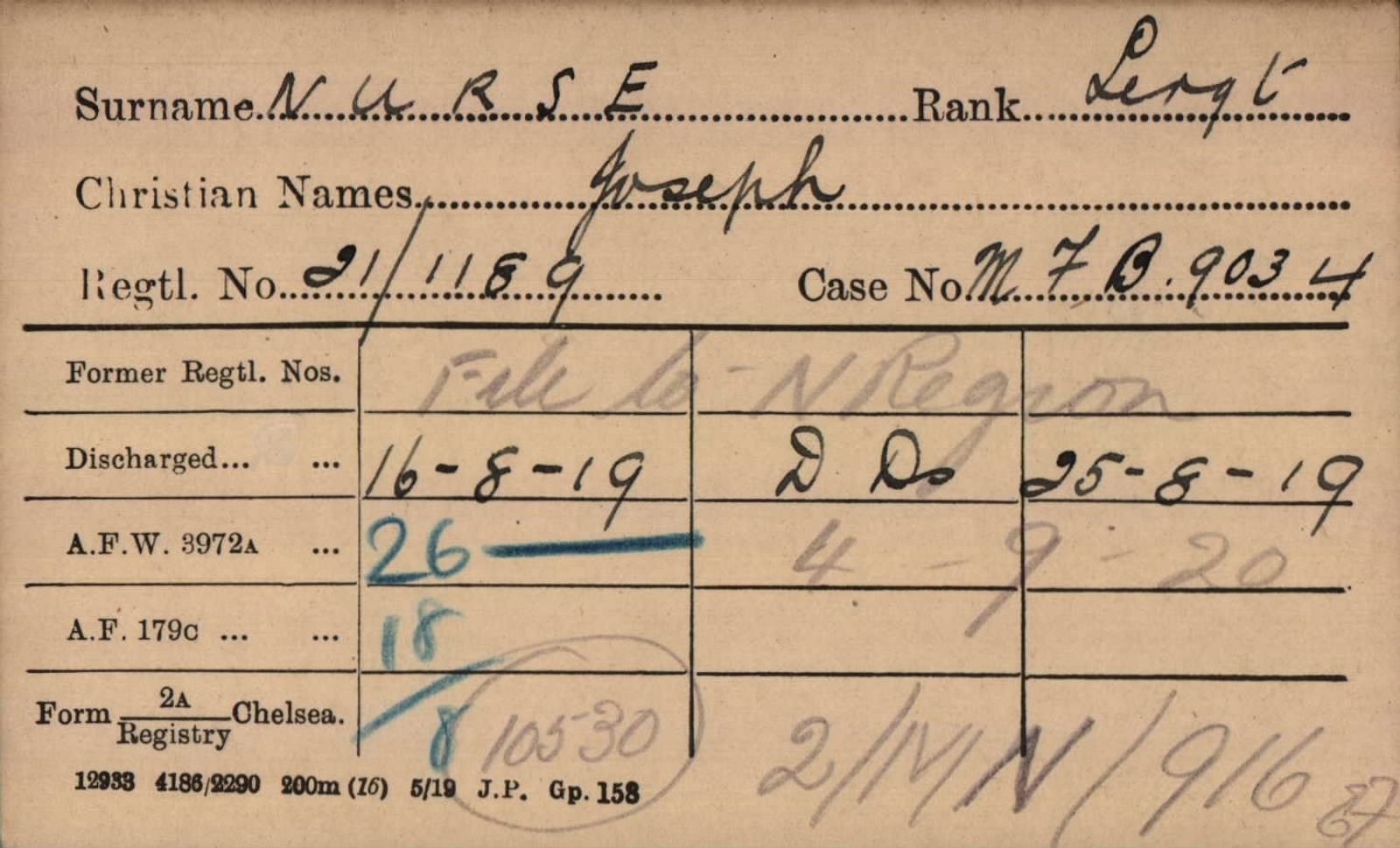
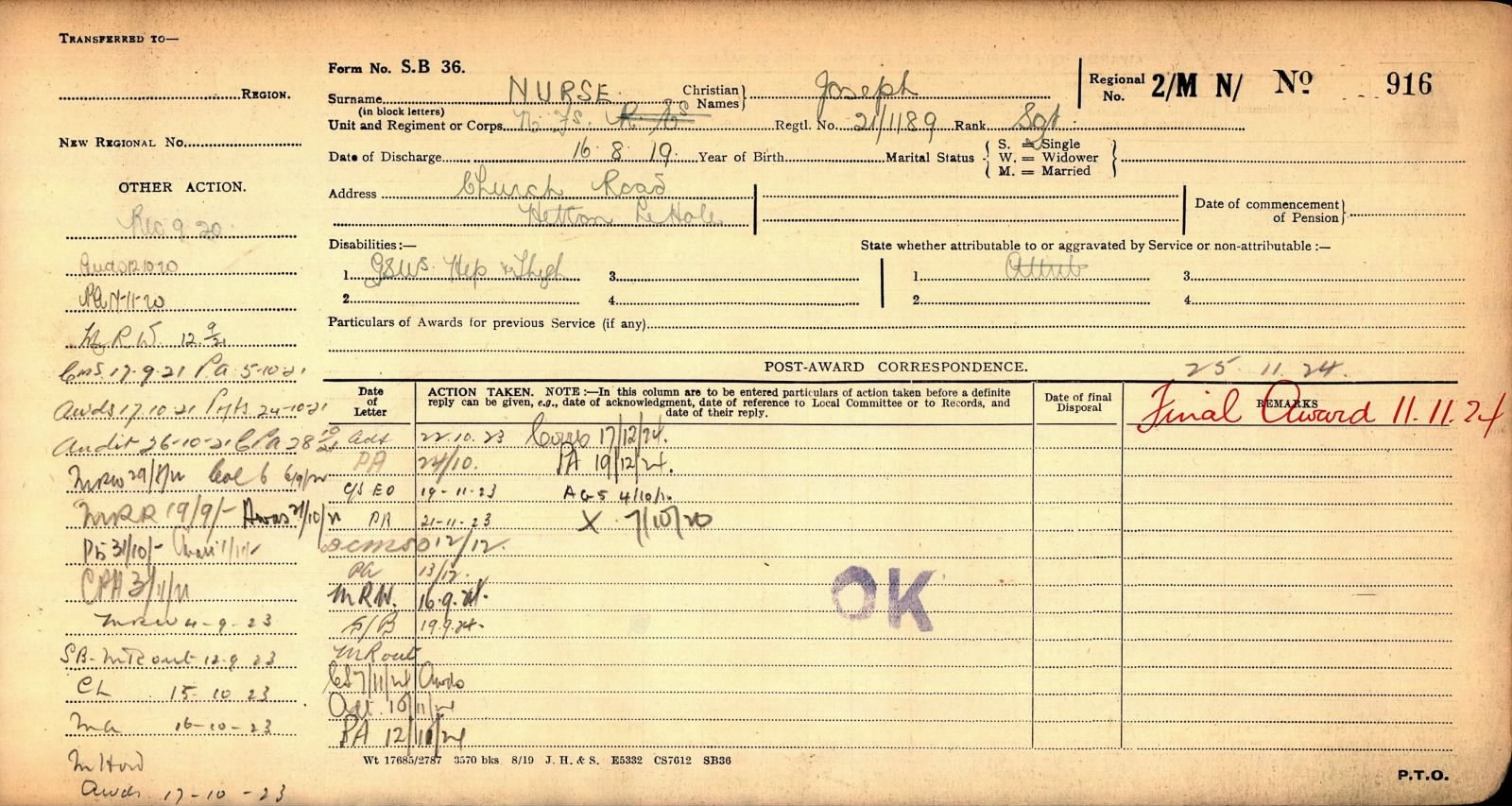
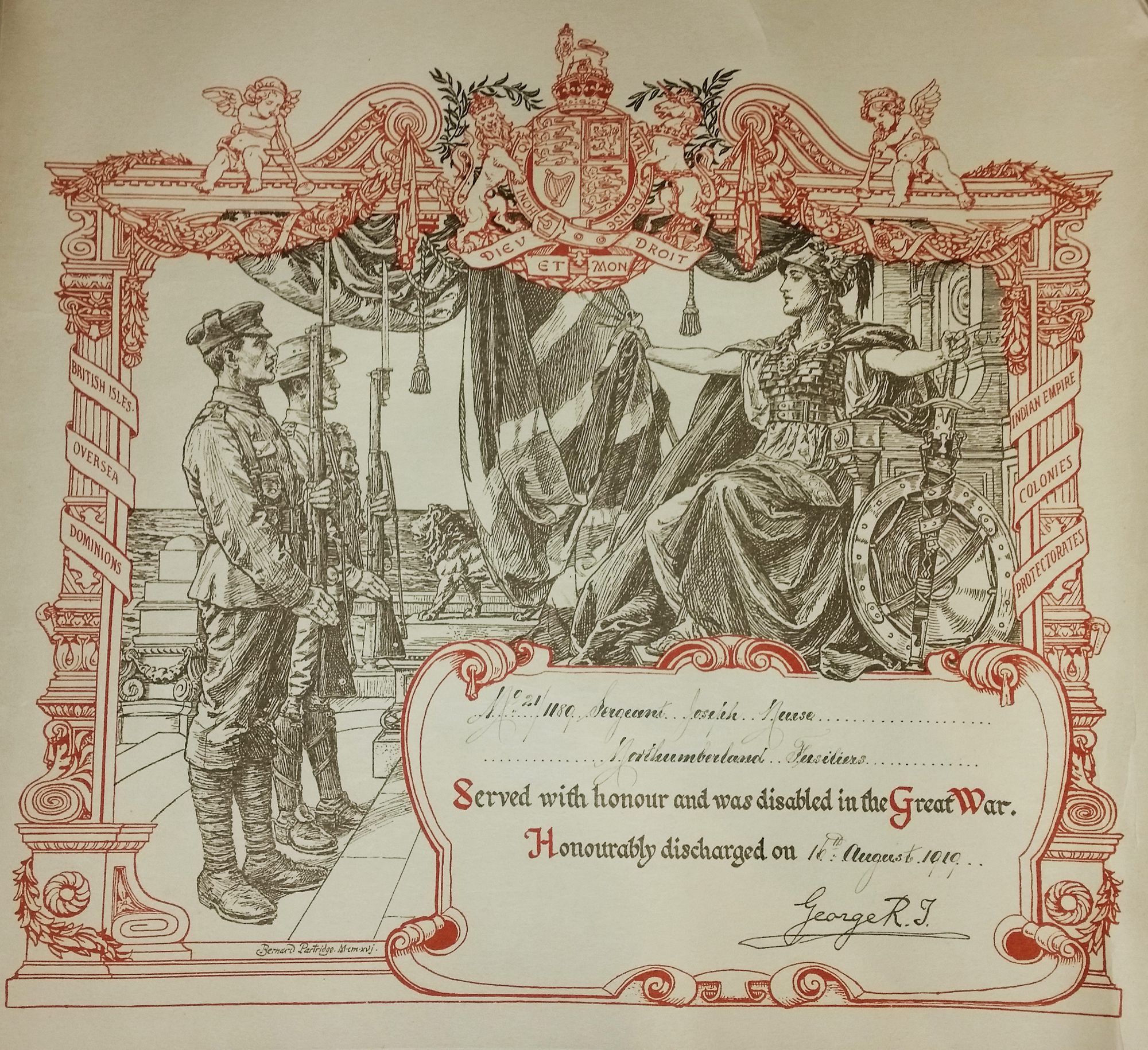
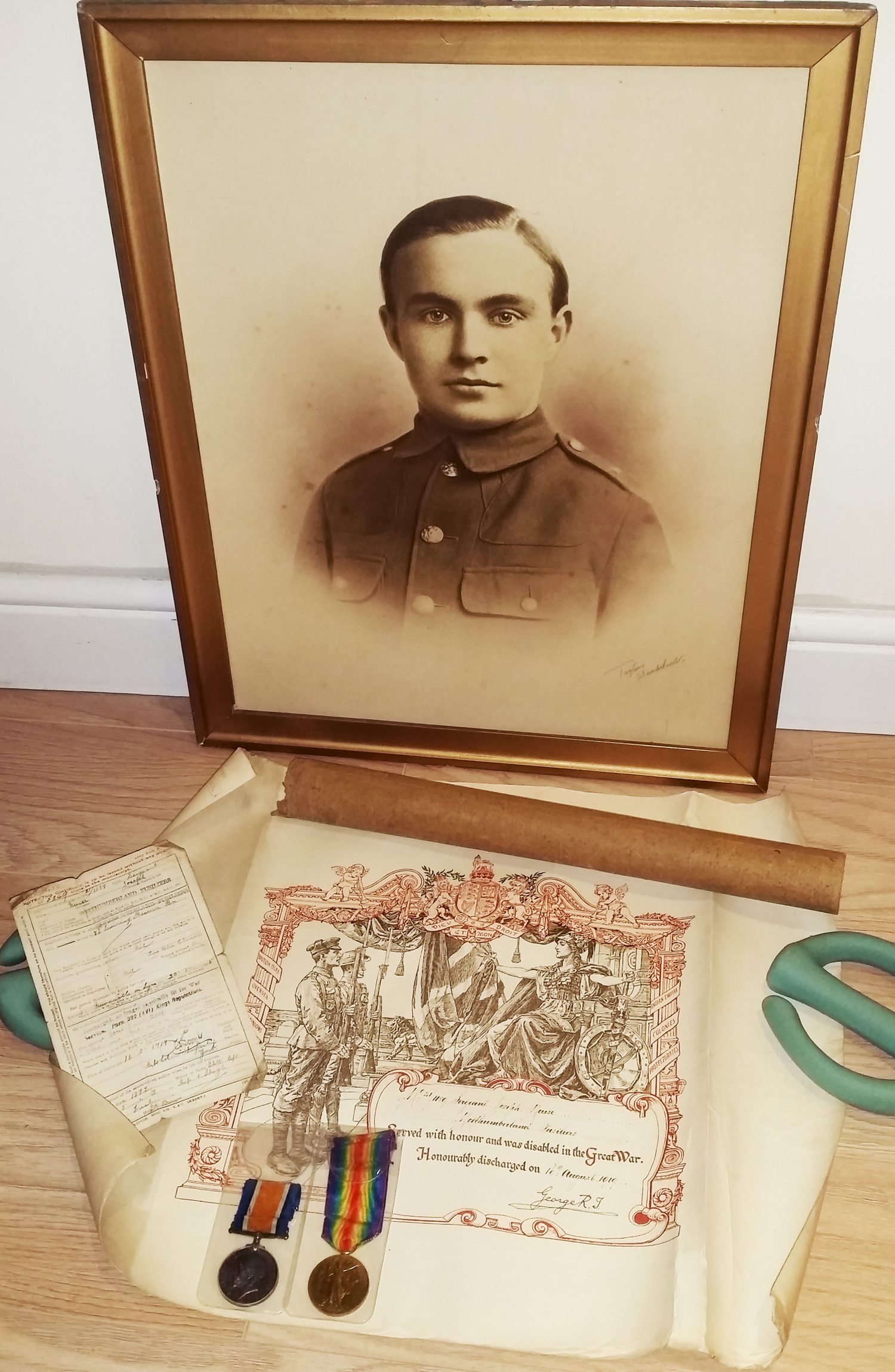
Joseph Nurse would ultimately survive his wounds and later be discharged from the Depot Battalion as “no longer physically fit for war service,” due to gunshot wounds to the hip and thigh. Specifically, on 16th August 1919, having transferred, after recovery, to lighter duties prior to discharge. Possibly he was transferred on the paperwork only, but in actual fact was sent on home on furlough.
Joseph was awarded two blue chevrons (one for each year of completed overseas service) and one “wound stripe” on his uniform. Upon discharge he was awarded a silver War Badge to show he had previously served and been discharged.
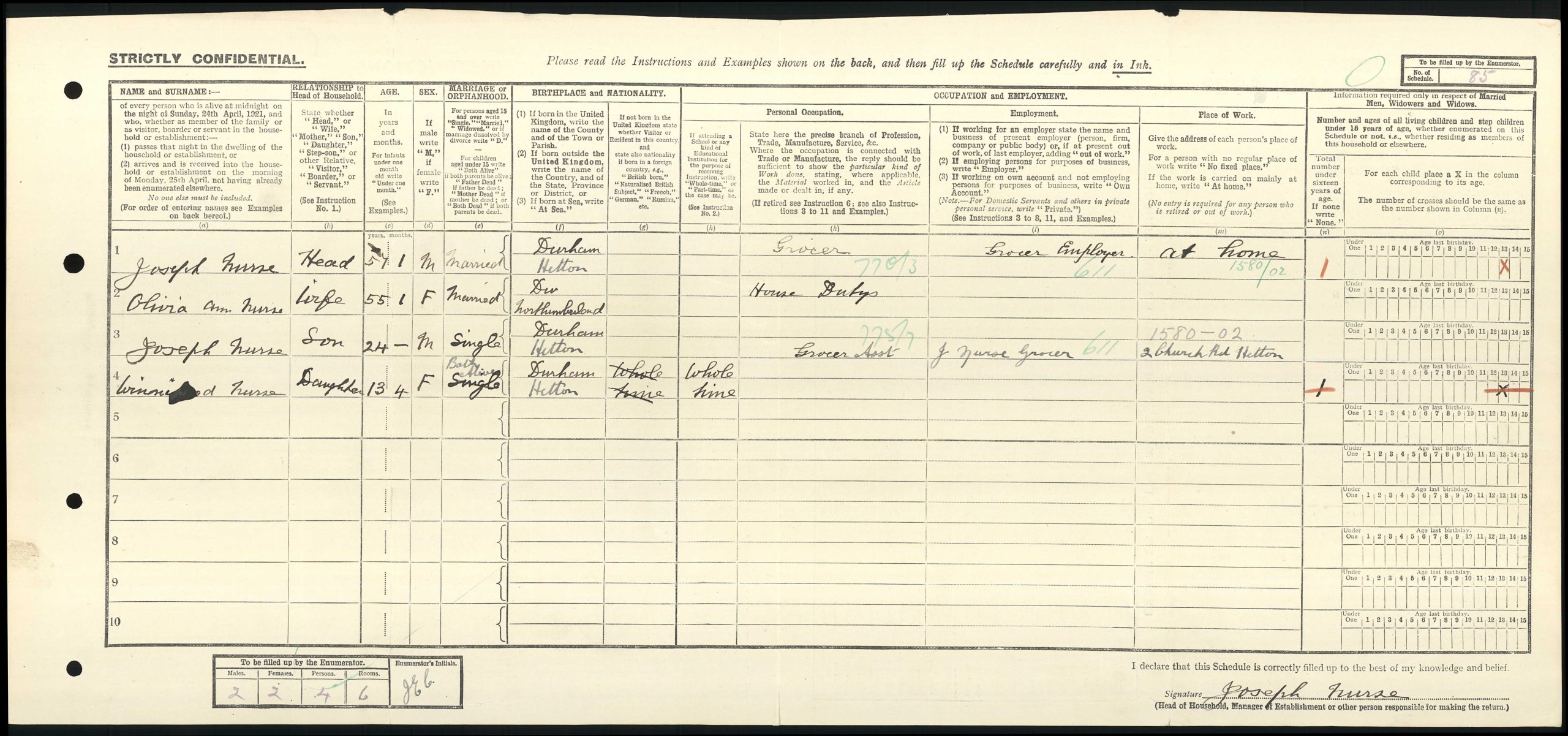
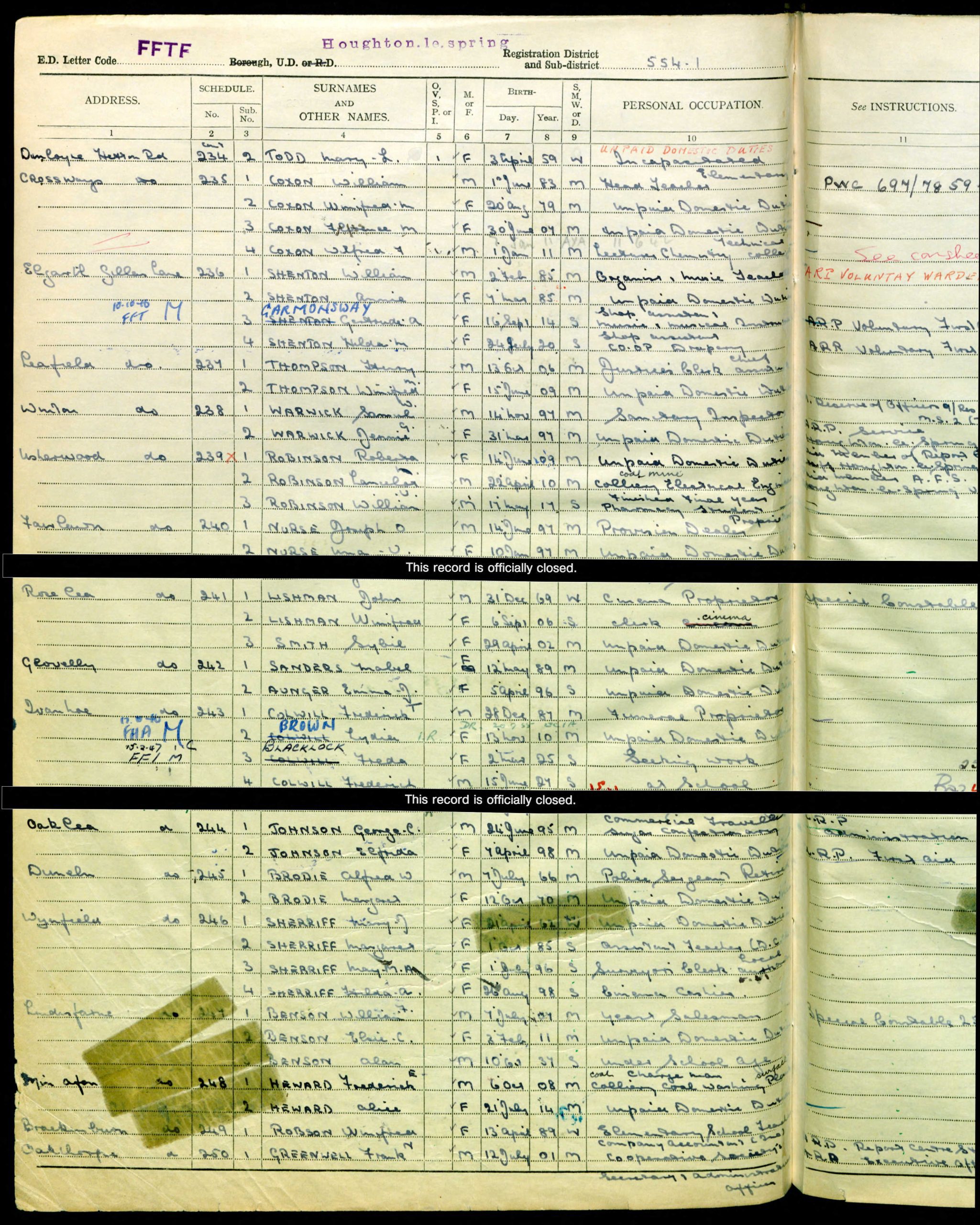
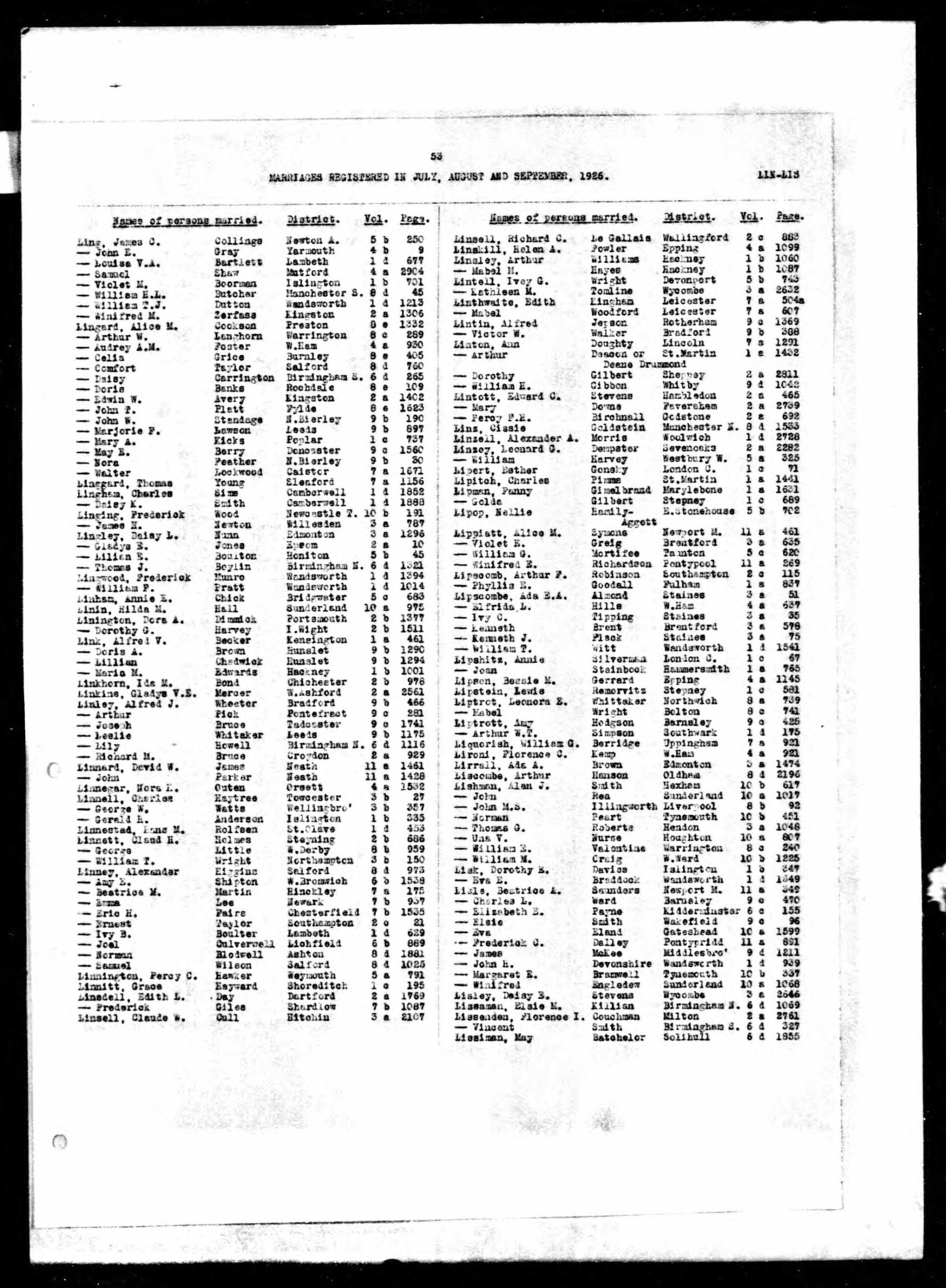
On the 1921, he was back working as a grocer’s assistant in his Father’s shop at 2 Church Road, Hetton Le Hole. In 1926 he married Una Victoria Lishman in Houghton-le-Spring, near Sunderland, and on the 1939 register they are living together on Green Lane there.
Joseph died in 1970, aged 73. His death was registered in Sunderland.
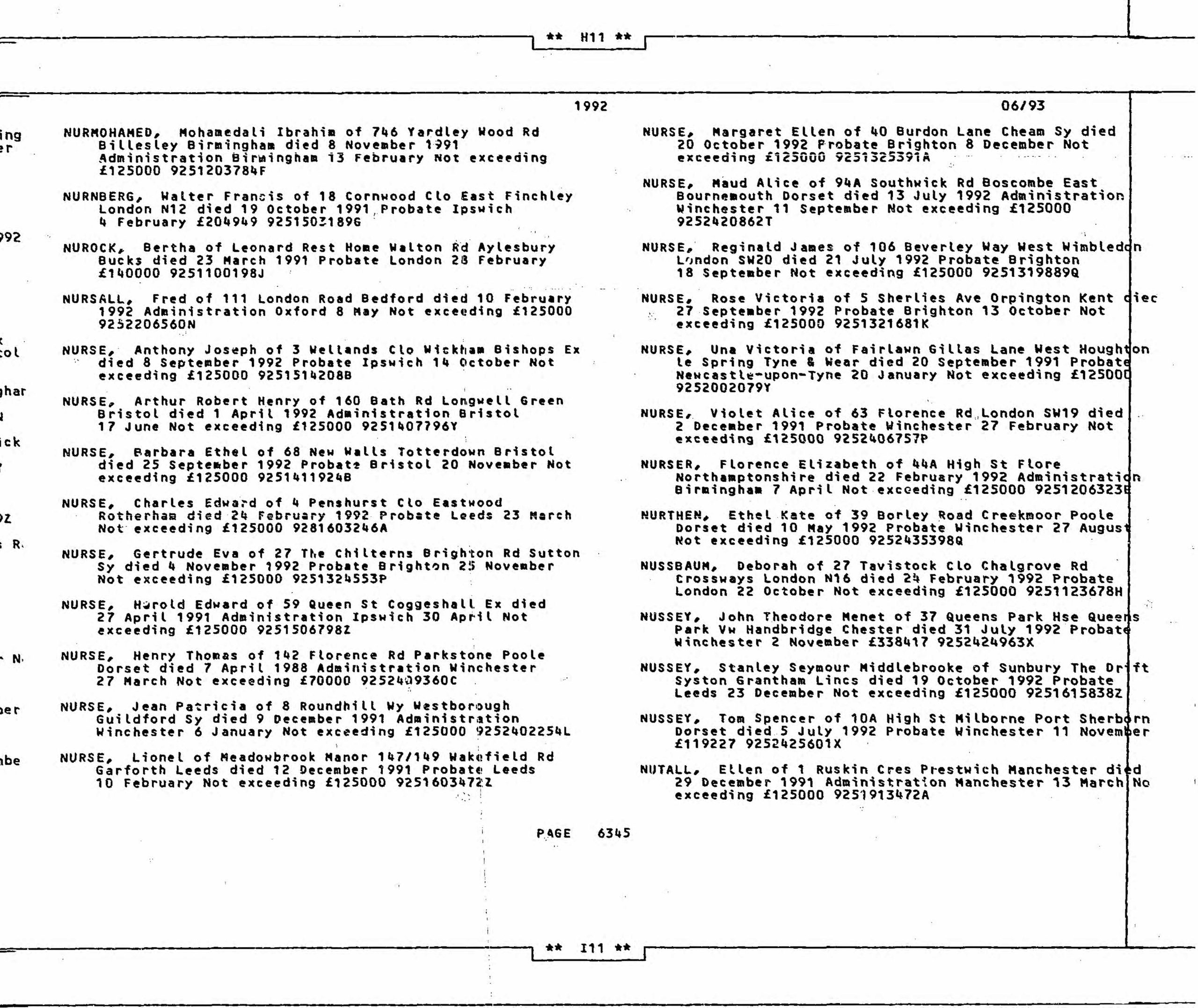
His wife, Una, died in 1991 aged 94. She left an estate worth £125,000
- 1901 Census
- 1911 Census
- 1921 Census
- 1939 Register
- Pension Index Card
- Pension Record
- Medal Index Card
- War Badge Roll
- Medal Roll
- Discharge Identity Document
- Discharge Identity Document - Rear
- Discharge Certificate
- Marriage Register - 1926
- Wife Una's Probate
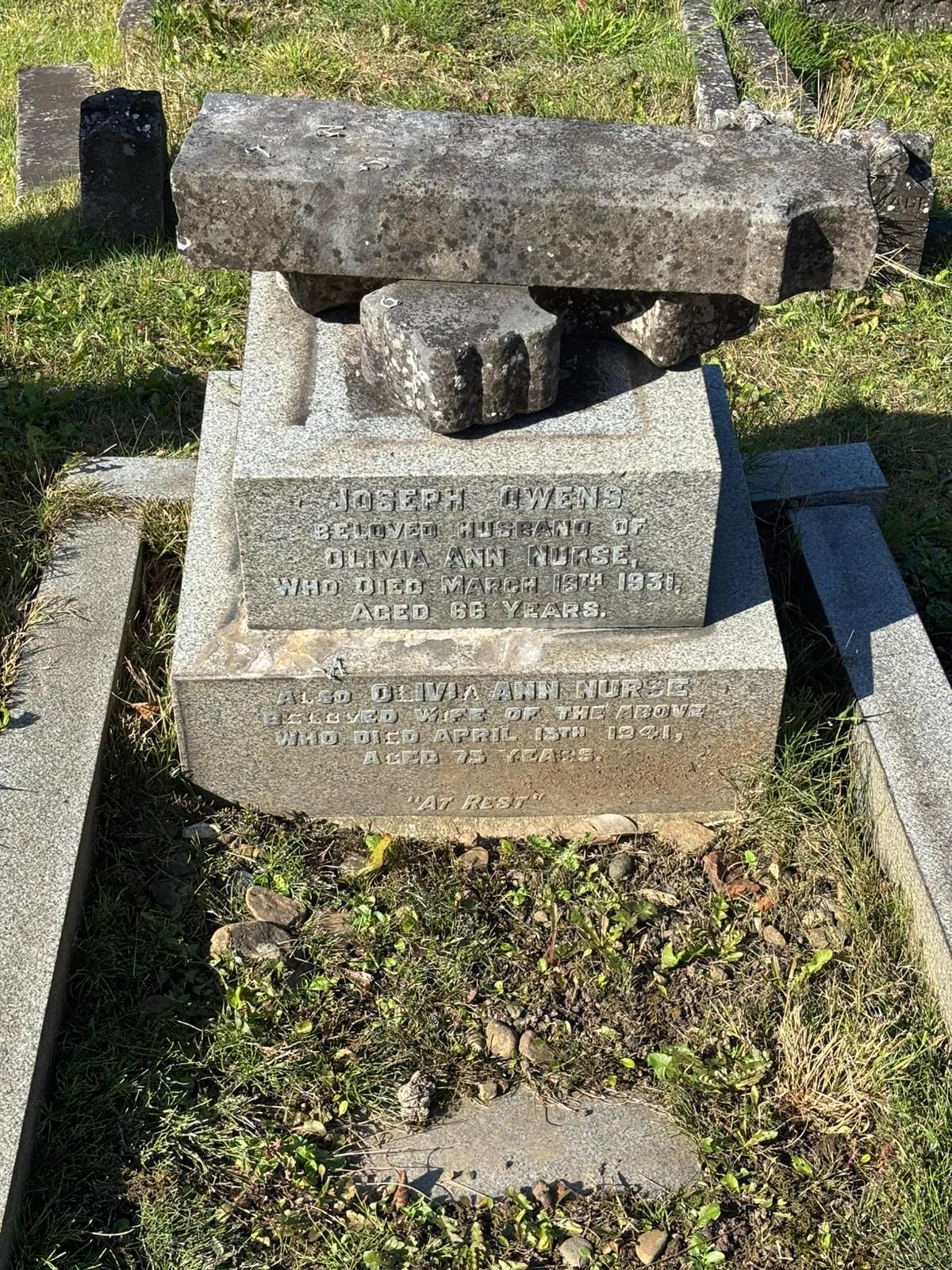
- Father's Grave
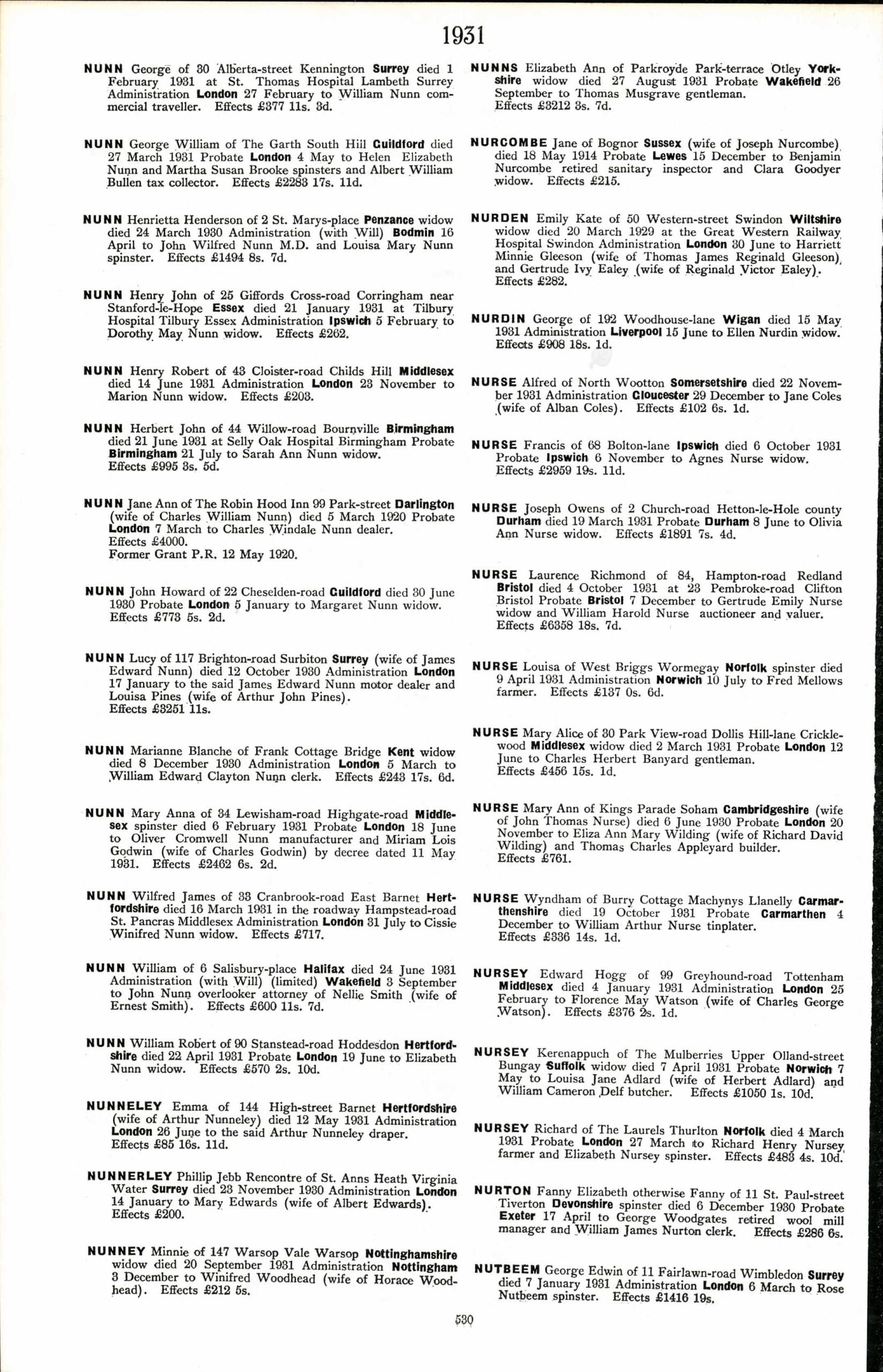
- Father's Probate Record
- Infant Sibling Burial Record